TL;DR
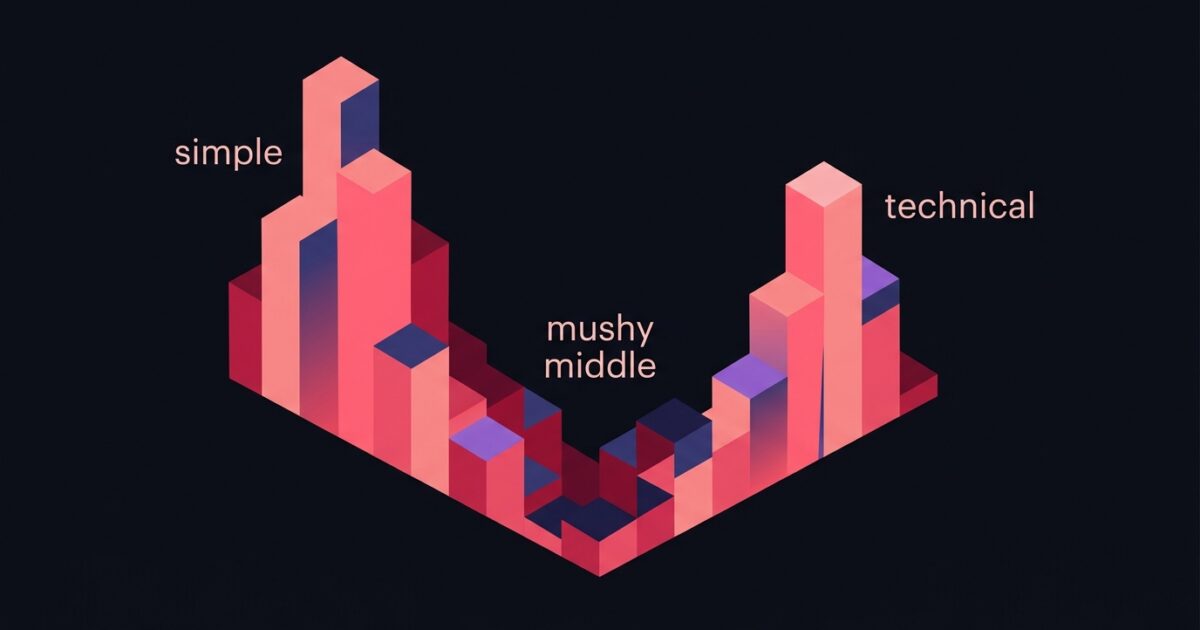
- Our May 2026 study of 153,425 AI citations reveals a bimodal readability distribution: 22.9% of cited sentences score Very Easy (Flesch 90+) and 20.5% score Very Confusing (Flesch under 30).
- The Fairly Difficult band (Flesch 50-59) draws only 2.6% of citations, the lowest of any band.
- Our earlier March 2026 study of 42,971 citations showed the same shape: 23.5% Very Easy, 21.3% Very Confusing, 5.0% at the Fairly Difficult valley.
- The pattern holds across two datasets and four times the sample size.
- Content in the 50-65 Flesch range, typical B2B marketing copy, performs worst.
- Register must match query intent: informational queries require Flesch 80+ and technical queries require Flesch under 30.
- A textstat-based paragraph audit of your top posts will reveal which ones are stranded in the dead zone.
In our May 2026 study of 153,425 AI citations, readability does not form a bell curve. It forms two peaks. 22.9% of cited sentences score Very Easy (Flesch 90+) and 20.5% score Very Confusing (Flesch under 30). The band in between, Fairly Difficult (Flesch 50-59), draws only 2.6% of citations. The middle register is the worst place to write.
The May 2026 bimodal finding
In our May 2026 study of 153,425 citations, we scored every cited sentence with Flesch Reading Ease using the textstat library. The full distribution:
| Flesch Band | Score Range | May 2026 Citations (%) |
|---|---|---|
| Very Easy | 90-100 | 22.9% |
| Easy | 80-89 | 12.0% |
| Fairly Easy | 70-79 | 4.4% |
| Standard | 60-69 | 13.1% |
| Fairly Difficult (dead zone) | 50-59 | 2.6% |
| Difficult | 30-49 | 24.5% |
| Very Confusing | under 30 | 20.5% |
The dead zone is Flesch 50-59. It attracts the fewest citations of any band. The two peaks at opposite ends are what give this pattern its name: bimodal distribution. An earlier version of this finding appeared in our March 2026 study of 42,971 citations, which showed Very Easy at 23.5% and Very Confusing at 21.3%, with the Fairly Difficult band at 5.0%. The May window confirms and sharpens the same shape on a dataset nearly four times larger.
The bimodal shape is not subtle. If readability were irrelevant to citation selection, the distribution would be roughly flat across bands. Instead it is deeply U-shaped with the trough at exactly the register most B2B marketing copy occupies.

Why the middle register loses
Content that scores Flesch 50-59 tends to share three structural problems. Each one makes a sentence harder for an AI retrieval system to treat as an atomic, extractable fact.
- Corporate hedging language. “Solutions designed to optimise stakeholder outcomes through innovative methodologies.” This sentence sounds authoritative but asserts nothing falsifiable. AI extraction needs a claim it can cite against a query. Hedged prose gives it nothing to anchor on.
- Mid-length compound structure. Sentences in the 12-18 word range with one main clause and one subordinate clause are the signature of middle-register writing. They are too long to be atomic sentences and too short to carry real technical depth.
- Vague qualifier stacking. “Often, in many cases, businesses may find that…” Multiple hedges in sequence signal low confidence to the extraction algorithm. Hedged, multi-clause prose of this kind does not appear in the cited set; the retrieval pipeline rewards single-claim atomic facts.
None of those patterns get cited at meaningful rates. The Fairly Difficult valley is where most B2B blog content lives. That is why so many companies rank organically but earn almost no AI search share of voice.
Match register to query intent
The bimodal distribution does not mean you should always write simply. It means register must match intent. The two citation peaks serve different query types, and a single article cannot win both.
- Consumer or informational query (e.g. “what does metformin do”): target Flesch 80+. Short sentences, common vocabulary, direct definitions. The Very Easy peak (22.9% of citations) comes from content written this way.
- Specialist or technical query (e.g. “mechanism of action of metformin in AMPK signaling”): target Flesch under 30. Precise terminology, named pathways, dense causal chains. The Very Confusing peak (20.5% of citations) comes from academic and technical docs written for expert readers.
- Structured comparison query (e.g. “best CRM for SaaS”): a comparison table with short, declarative cell values can straddle registers. The table format itself is a high-citation content format.
The wrong move is writing at Flesch 55 hoping it appeals to both audiences. It appeals to neither. The Google AI Mode optimization playbook we use with clients separates every pillar post into a declared register from the first paragraph.
How to test your own content’s Flesch profile
Run a Flesch scan over your highest-traffic posts. The Python script below uses the textstat library (install with pip install textstat) to score and bucket every paragraph in a post.
import textstat

def classify_flesch(score):
    if score >= 90:
        return "Very Easy"
    elif score >= 80:
        return "Easy"
    elif score >= 70:
        return "Fairly Easy"
    elif score >= 60:
        return "Standard"
    elif score >= 50:
        return "Fairly Difficult (dead zone)"
    elif score >= 30:
        return "Difficult"
    else:
        return "Very Confusing"

def audit_post(paragraphs):
    results = []
    for i, p in enumerate(paragraphs):
        score = textstat.flesch_reading_ease(p)
        band = classify_flesch(score)
        results.append({"paragraph": i + 1, "score": round(score, 1), "band": band})
    return results

# Usage: split your post text into a list of paragraph strings
paragraphs = [
    "AI search citations show a bimodal readability distribution.",
    "The mechanism involves AMPK phosphorylation via LKB1 activation.",
]
for r in audit_post(paragraphs):
    print(r)
Run this across your top 20 posts. Histogram the results. If most of your paragraphs land in the 50-65 band, you are sitting in the citation-poor middle. The fix is not to edit every word; it is to identify each post’s target register based on its query intent and rewrite the opening three paragraphs to anchor the register. Those paragraphs sit in the top citation zone of the document and carry the most extraction weight.
The grade-level data confirms the same shape
Flesch-Kincaid grade levels tell an identical story. From our May 2026 study (153,425 citations), the grade-level distribution also showed bimodal shape:
| Grade Band | March 2026 Citations (%) |
|---|---|
| Elementary (4th grade or below) | 39.1% |
| Middle School (5-6) | 12.8% |
| Junior High (7-8) | 12.3% |
| High School (9-10) | 13.8% |
| Senior High (11-12) - the valley | 1.9% |
| College+ (13+) | 20.4% |
The middle grade-level registers are the most underperforming buckets: too polished for plain English, not technical enough for specialists. They are the grade-level equivalent of the Flesch 50-59 dead zone. Avoid them.
How to rewrite toward the peaks
Practically, the rewrite path differs depending on which peak you are targeting. Our content strategy service uses a register-first editing pass on every article before publishing.
Rewriting toward Very Easy (Flesch 80+)
- Replace every phrase with its shortest equivalent. “In order to” becomes “to.” “At this point in time” becomes “now.”
- Break compound sentences at the conjunction. One idea per sentence.
- Front-load the subject and verb. Avoid inverted constructions.
- Use second person (“you”) to tighten sentence length naturally.
- Target 6-10 word sentences. Our atomic sentence research shows the 6-10 word range accounts for 45.2% of all citations in the May 2026 study.
Rewriting toward Very Confusing (Flesch under 30)
- Use field-specific terminology without apology or parenthetical definition (definitions belong in a glossary page).
- Include quantitative precision: named values, units, confidence intervals.
- Reference named methods, frameworks, and papers. Dense citation prose signals expertise.
- Longer technical sentences are fine if every word carries semantic load. Avoid filler.
Applying the bimodal lens to a content audit
In our client work we use a three-step register audit before any GEO content rewrite:
- Classify every existing post by query intent. Informational queries get assigned Very Easy target. Technical and specialist queries get Very Confusing target. Comparison queries get structured table format.
- Run the Flesch audit script above on the top 35% of each post by position. Those paragraphs are the primary citation zone.
- Rewrite paragraphs in the 50-65 band toward the target register. Do not rewrite paragraphs already in the right peak. Our content pruning data shows that targeted rewrites of the opening third of a post produce the largest citation lift per hour of editorial work.
The GEO/AEO Tracker we built and open-sourced at github.com/danishashko/geo-aeo-tracker measures citation rates across platforms after each content update, so you can directly observe the register shift’s effect on citation frequency. Pair it with the Flesch audit script above to close the feedback loop.
The bimodal finding also has implications for pillar and cluster architecture. A single pillar post cannot serve both register peaks. The better structure is a plain-language pillar for broad informational queries supported by technical cluster posts for specialist sub-queries. Each piece targets its own peak. The cluster posts link back to the pillar for navigational coherence and the pillar links forward to the technical depth for authority signals.
If you want us to run the register audit on your content and map the rewrite roadmap, our GEO audit service includes a full Flesch profiling pass across your top 50 posts alongside the positional and sentence-length audits from our broader citation research.