TL;DR
- Repurposing one core piece of content into multiple formats is the highest-ROI lever for AI citation coverage.
- Our May 2026 study (153,425 citations across 6 platforms) found YouTube leads with 9,868 citations, Reddit follows with 6,595, and Wikipedia places seventh with 1,483.
- Each engine has distinct source preferences: Gemini from YouTube, ChatGPT from Reddit, Copilot from LinkedIn, Grok from X.
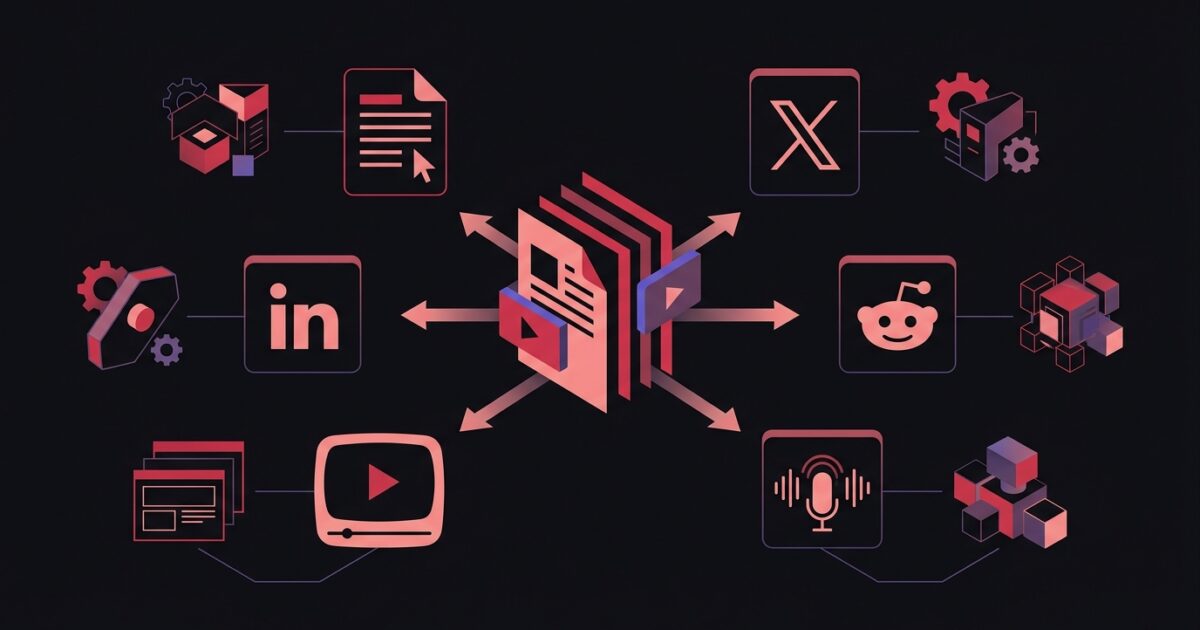
- Systematic 7-format repurposing across blog, LinkedIn, Reddit, YouTube, X, podcast, and LinkedIn documents captures citations across all engines.
- Mean cited sentence length is 9.27 words; 74.9% of cited sentences appear in the first half of the document.
- A 7-day staggered release sequence compounds indexing velocity across formats.
Repurposing one core piece of content into multiple formats is the highest-ROI lever for expanding your AI citation surface area, because each AI engine retrieves from a different set of platforms.
Why single-format publishing limits AI citation reach
Our March 2026 study decoded 42,971 citations across six AI platforms. YouTube led with 1,525 citations. Reddit followed with 1,444 citations. Wikipedia placed third with 975 citations. These are not interchangeable. A brand publishing only blog posts appears in none of the top three citation sources by volume.
Our May 2026 study of 153,425 citations confirmed the pattern at scale: YouTube generated 9,868 citations and Reddit 6,595 in that window alone. The engines driving those citations differ: Gemini draws heavily from YouTube, ChatGPT draws heavily from Reddit, and Copilot draws from LinkedIn. A brand publishing in only one format is structurally capped at one or two engines.
The solution is systematic multi-format repurposing: turning one core insight into 5-8 platform-specific variants so each major engine has a high-relevance source to cite. Our March citation study and May citation study both confirm that platform diversity is the primary driver of cross-engine citation coverage.
Multi-format repurposing is the only way to capture citations across all six major AI engines. Each engine has distinct source preferences.
The engine-to-format citation map
Each AI engine has documented source preferences shaped by training data, retrieval architecture, and platform partnerships. Understanding those preferences lets you reverse-engineer which formats to prioritize.
| AI Engine | Primary citation sources | Format to prioritize |
|---|---|---|
| Google Gemini | YouTube (9,868 citations in our May study), Google-owned properties | YouTube video + transcript |
| ChatGPT | Reddit (6,595 citations in our May study), Bing-indexed web | Reddit posts + long-form blog |
| Microsoft Copilot | LinkedIn (now a top-5 source per our Copilot tracking), Bing index | LinkedIn long-form article |
| Perplexity | Reddit (6,595 citations in May study), curated web sources | Reddit + structured blog |
| Grok | X posts and threads, X-native content | X thread with data points |
| Google AI Mode | Owned-site content, blog posts, structured data | Long-form blog with schema |
The pattern from our research is clear: YouTube, Reddit, and Wikipedia dominate raw citation volume. LinkedIn has emerged as the key vector for Copilot. Grok is the only engine where X-native content is a primary lever. No single format covers more than two or three engines well.

The 7-format repurposing matrix
These seven formats map to the major citation sources in our research. Produce all seven from one core asset and you have representation across every major engine.
1. Long-form blog post (canonical anchor)
The blog post is the architectural anchor. Schema markup, citations, depth, and internal linking live here. Target 2,000-4,000 words with clear H2/H3 structure and embedded data. Our May 2026 data shows 74.9% of cited sentences appear in the first half of the document, so front-load your strongest claims. Google AI Mode draws primarily from owned-site blog content, making this the foundation for that engine.
2. YouTube video with transcript
YouTube generated 9,868 citations in our May 2026 study window. Gemini retrieves from YouTube above all other platforms. A 10-15 minute video generates 2,000-4,000 words of transcript that AI engines crawl as text. YouTube SEO for AI citations is its own discipline: manually edited transcripts, structured timestamps, and a description that mirrors your blog post architecture. Upload an SRT file rather than relying on auto-generated captions alone. The full playbook for transcript optimization is in our video transcripts guide.
3. Reddit contribution
Reddit generated 6,595 citations in our May study. ChatGPT and Perplexity both weight Reddit heavily. The Reddit SEO playbook is different from other platforms: genuine community contribution beats promotional content. Answer a specific question with detailed, actionable insight, or share a counterintuitive finding with data behind it. Link to your blog post only where it genuinely adds depth.
4. LinkedIn long-form article
LinkedIn has risen to a top-5 citation source in our Copilot tracking. Our LinkedIn AI citation guide covers the structural differences from a blog post: 1,200-1,800 words, personal hook opening, short paragraphs of 2-3 sentences, first-person practitioner voice. The critical adaptation is the introduction. LinkedIn readers stop scrolling for specific, relatable scenarios, not problem definitions. Copilot optimization starts with a strong LinkedIn presence.
5. Podcast appearance with show notes
Podcast transcripts carry dual citation value: the host authority plus your expert positioning. Podcast transcripts are the only podcast format AI engines can cite than the audio alone. When you appear, request that the host publishes detailed show notes with your full name, company, website link, and specific topics covered. Many transcription services auto-generate structured show notes. Use them.
6. X thread
Grok retrieves from X-native content above other sources. An X thread is the only format with a direct path to Grok citations. Structure: punchy opening claim, numbered framework points, one visual with data, link to full blog post. Keep each tweet under 240 characters and front-load the strongest data point in tweet one.
7. LinkedIn document or SlideShare
Document posts on LinkedIn generate higher organic reach than standard articles in many B2B niches. A 10-15 slide summary of your core framework, with one data point per slide, serves both LinkedIn readers and Copilot retrievers. Include your blog post URL on the final slide.
YouTube for Gemini, Reddit for ChatGPT and Perplexity, LinkedIn for Copilot, X for Grok. No single format covers more than two engines.
The adaptation rules: not duplication, reformatting
Effective repurposing is structural adaptation, not copy-paste. Each platform has distinct norms and AI retrieval engines pick up on those norms. Verbatim cross-posting underperforms because the content signals do not match the platform context.
- Blog post structure: Problem, context, framework, evidence, application, conclusion. Use BLUF formatting with the key claim in the first sentence.
- LinkedIn article structure: Specific relatable hook, personal practitioner story, framework, quick wins, blog link.
- Reddit post structure: Specific question or counterintuitive claim, supporting evidence, invite critique and discussion.
- X thread structure: Punchy opening claim, numbered framework points (one per tweet), visual data, link to full resource.
- YouTube video structure: Problem hook in first 30 seconds, timestamped sections matching your H2 structure, call-to-action to blog post.
Our May 2026 study found the mean cited sentence is 9.27 words long. Atomic, declarative sentences outperform long complex ones across all platforms. Write the same way on Reddit, YouTube transcripts, and LinkedIn as you do in your blog: one fact per sentence, 6-15 words each.
The pillar-cluster architecture applies across formats. Each variant should reference the canonical blog post to create citation flow back to the authority anchor. Data journalism is the highest-ROI content type: original research and unique data points travel across formats and get cited by AI engines at higher rates than opinion content.
The 7-day staggered release sequence
Publishing all formats simultaneously wastes indexing momentum. Staggered distribution with strategic cross-linking compounds both engagement and AI discovery.
- Day 0: Blog post. Full schema, citations, internal links. Let it index for 24-48 hours before cross-posting.
- Day 2: LinkedIn article. Adapted intro and structure. Links back to blog for deeper context.
- Day 3: Reddit contribution. In a relevant subreddit. Selective link to blog if it genuinely adds value.
- Day 4: X thread. Teases the framework and drives to blog.
- Day 5: LinkedIn document. Visual summary of the framework.
- Day 7: YouTube video. Blog link in description and pinned comment. Transcript uploaded.
- Day 14 or sooner: Podcast. Coordinate timing with host. Show notes published same day as episode.
This sequence creates multiple AI discovery entry points while maintaining the blog post as the canonical authority anchor. Citation velocity compounds when formats go live in temporal proximity: AI engines update their retrieval indexes continuously, and a cluster of content across platforms signals topical relevance.
Staggered format release over 7 days creates multiple AI discovery pathways. Each format acts as distribution amplification for the canonical blog post.
B2B vs. consumer format priorities
Not every brand needs all seven formats at full production quality. Our readability research shows AI engines cite both highly technical and highly simple content, but the platforms they retrieve from differ by query type.
For B2B SaaS and professional services, the core stack is: long-form blog, LinkedIn article, YouTube video. Reddit and X add incremental reach but rarely become primary citation drivers unless you invest consistently in community engagement. Our GEO for B2B SaaS playbook details how to sequence these for enterprise buying journeys.
For consumer and creator brands, the pattern is different: Reddit, YouTube, and X dominate citations because ChatGPT and Perplexity weight community and social signals for consumer queries. LinkedIn is secondary for consumer intent.
Tracking citation attribution by format
Track which formats drive citations per AI engine using the GEO/AEO Tracker. Most brands discover that 2-3 formats generate 80% of citation volume for their audience. Identify those formats and invest production budget where it compounds.
Measure three metrics per format: direct citations (AI cites the format URL directly), attribution citations (AI cites the blog post after discovery via another format), and cross-format lift (total citation increase when all formats are live versus blog-only baseline). Track share of voice by engine to see which formats move the needle for your category.
In our client work, we run a simple 90-day test: blog-only for half the content calendar, full multi-format for the other half. The citation delta between the two groups reveals the ROI of the repurposing investment for that specific audience and topic.
For advanced tracking, connect GA4 to your AI referral attribution setup as described in our GA4 AI referral attribution guide. Segmenting by traffic source lets you correlate format publication dates with citation spikes.
Run a 90-day split test: blog-only versus full multi-format for the same topics. The citation delta is your ROI proof for the repurposing investment.
Platform licensing and AI training data
Platform dominance in AI citations is partly structural. Content licensing deals between AI companies and platforms determine which sources get preferred retrieval. YouTube (Google-owned), Reddit (which signed data licensing deals with multiple AI companies in 2024), and Wikipedia are not dominant by accident. They have scale, structure, and in some cases explicit data agreements that smaller platforms do not have.
This means the format-to-engine mapping is durable. The platforms our research identifies as dominant citation sources are dominant for structural reasons, not ephemeral algorithm quirks. Invest in the formats that map to the platforms with scale and structural AI relationships.