TL;DR
- YouTube, Reddit and Wikipedia led every platform we studied through May 2026.
- ChatGPT broke that pattern in August 2026, dropping Reddit to 0.9% of its citations.
- Our May 2026 study of 153,425 citations: YouTube 9,868, Reddit 6,595, Wikipedia 1,483.
- All three share extractable text, dense facts and long-standing entity authority.
- Compete by earning presence on them or copying their structure on your own domain.
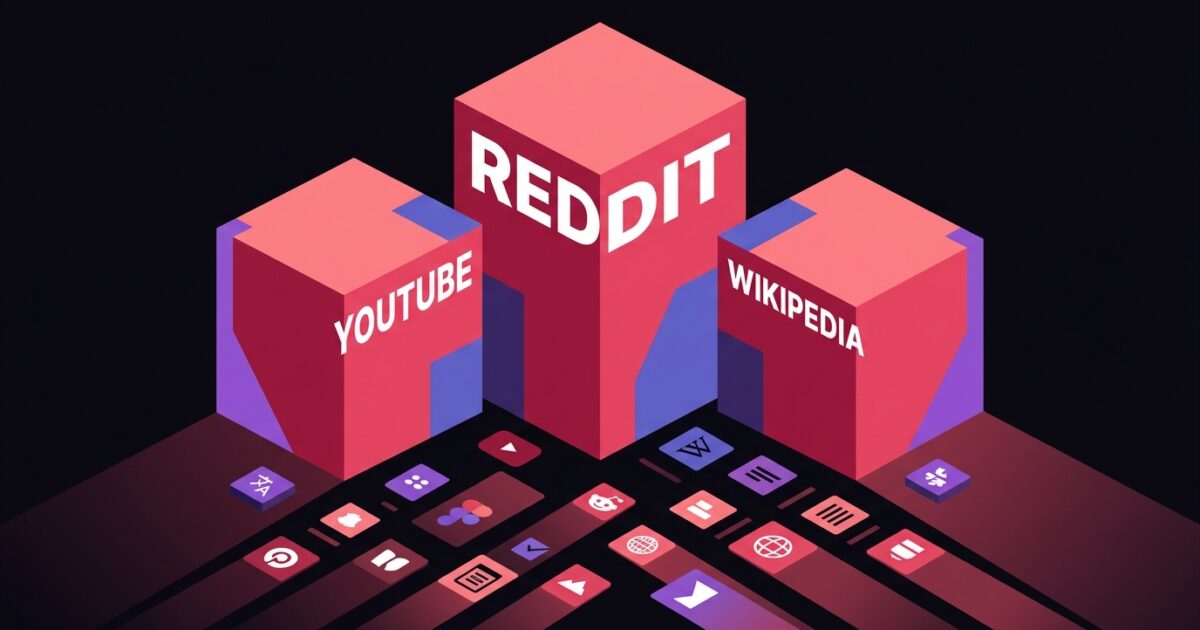
Across 153,425 AI citations on 6 platforms, YouTube (9,868 citations), Reddit (6,595 citations), and Wikipedia (1,483 citations) are the three most-cited domains on the web. The dominance held across every measurement window and platform in those studies.
Update, 24 August 2026. The three-domain pattern below still holds in Google AI Mode, Perplexity and Gemini. It stopped holding in ChatGPT. In a 100-prompt run on 23 August 2026, Reddit took 0.9% of ChatGPT’s citations against 8.1% in Google AI Mode and 10.7% in Perplexity. Read any cross-engine dominance claim as engine-specific from August 2026 on.
The data: top 10 cited domains (May 2026 study)
Our 153,425-citation study covered AI Mode, Gemini, ChatGPT, Perplexity, Copilot, and Grok. Here are the top 10 domains ranked by total citations in that May 2026 window:
| Rank | Domain | Citations (153,425-citation study, May 2026) | Queries cited in |
|---|---|---|---|
| 1 | youtube.com | 9,868 | 3,469 |
| 2 | reddit.com | 6,595 | 2,248 |
| 3 | pmc.ncbi.nlm.nih.gov | 2,273 | 741 |
| 4 | medium.com | 2,269 | 876 |
| 5 | linkedin.com | 2,267 | 988 |
| 6 | facebook.com | 1,488 | 914 |
| 7 | en.wikipedia.org | 1,483 | 895 |
| 8 | instagram.com | 1,091 | 682 |
| 9 | mayoclinic.org | 1,045 | 280 |
| 10 | investopedia.com | 795 | 386 |
YouTube leads every domain by a wide margin at 9,868 citations. That is universal-source behavior. Google uses Wikipedia as a reference anchor in classic search; AI engines use YouTube the same way. Reddit at 6,595 citations is the clear number two. No brand-owned domain in our dataset comes close to either figure.

The May 2026 data: dominance confirmed at scale
Our May 2026 study expanded to 153,425 citations. YouTube reached 9,868 citations and Reddit reached 6,595. Both platforms held their top-two positions by a wide margin. The structural reasons for their dominance did not change between windows; the absolute citation volumes grew as AI search usage expanded.
The May data also showed that 74.9% of cited sentences appeared in the first half of documents and that mean cited sentence length was 9.27 words. Both facts reinforce what the top domain list already suggested: AI engines extract short, front-loaded, atomic claims. YouTube chapter titles, Reddit post titles, and Wikipedia lead sentences are all structurally pre-optimized for that extraction pattern.
What the top three domains share structurally
These three platforms did not end up at the top by accident. Each shares four structural properties that map directly to what AI retrieval prefers.
- Text-extractable content at scale. YouTube provides machine-readable transcripts, chapter markers, and descriptions. Reddit threads produce hundreds of short, scoped comments on a single topic. Wikipedia renders structured HTML with infoboxes, tables, and clearly delimited lead sections. All three expose clean, crawlable text rather than locking content behind JavaScript or paywalls.
- Atomic-fact density. A YouTube chapter title is a one-line claim. A Reddit comment is naturally short and declarative. Wikipedia opens every article with a definitional sentence. All three formats produce a high density of short, falsifiable statements that fit the 9.27-word cited-sentence mean we measured.
- Engagement signals as quality proxies. Upvotes, view counts, and edit histories give AI retrieval systems a behavioral quality signal that brand-owned content cannot replicate. A Reddit thread with 1,000 upvotes has demonstrated crowd-validated relevance. A YouTube video with high watch time has demonstrated audience engagement. These signals function as distributed editorial review.
- Entity authority and cross-platform corroboration. YouTube, Reddit, and Wikipedia are cited by virtually every other authoritative source on the web. Their trust signals are reinforced by inbound links from billions of domains. AI engines carry strong priors that anything from these three domains is safe to surface. No brand site built in the last decade can match that prior without a deliberate multi-year effort.
Vertical concentration: healthcare authority in the top 10
Below the top three, the 153,425-citation data shows a sharp vertical concentration. PMC and Mayo Clinic are the fourth and fifth most-cited domains. Healthline, Cleveland Clinic, and Investopedia fill out the rest of the top 10.
This reflects two overlapping dynamics. First, AI engines apply stricter trust filters on YMYL queries (health, money, safety), favoring sources with institutional credentialing. Second, healthcare and finance publishers have the longest history of structured, expert-reviewed content. PMC articles carry named authors, DOIs, peer-review records, and citation networks. Mayo Clinic pages open with definitional summaries, list named medical reviewers, and reference primary research inline.
If you operate in a YMYL vertical, the bar is higher than structural optimization alone. Named author credentials, medical or legal review, and explicit citation of primary sources within the article body are table stakes for AI citation in these categories.
Strategy 1: earn presence on the platforms
The most direct path to appearing in AI citations is to publish on platforms AI engines already trust at a structural level. This is not a shortcut; it is a distribution strategy.
- YouTube: Publish a video for every major content topic on your blog. Use chapter timestamps as atomic-fact anchors. Our YouTube SEO for AI citations guide covers transcript optimization, chapter structure, and description formatting for AI retrieval. Transcripts get scraped directly by AI engines.
- Reddit: Participate authentically in subreddits adjacent to your category. The goal is not link-dropping; it is earning organic mentions in high-engagement threads. Our Reddit citation playbook covers which subreddits matter for B2B audiences and what signal a cited comment sends versus a brand post.
- Wikipedia: Ensure your category, your founders, and major industry concepts have well-cited Wikipedia articles. Our Wikipedia entity strategy guide covers the difference between directly editing brand-related pages (which violates policy) and contributing to the broader topic ecosystem (which builds the citation context AI engines use).
- Quora and LinkedIn: Both platforms appear in our dataset. Our Quora optimization guide and LinkedIn citation guide cover platform-specific formats that AI engines extract from each.
Strategy 2: replicate the structural signals on your own domain
If platform presence is not viable for your category, you can engineer the same structural properties on your own site. This is a longer-path play but it builds owned citation assets.
- Add transcripts to every video and podcast. Text content from video compounds atomic-fact density and gives AI crawlers something to extract. A video-only page is invisible to text-based retrieval.
- Build comprehensive glossary pages. Wikipedia dominates because every major concept in every field has a lead-sentence definition there. A glossary section on your own domain replicates the definitional page format. Lead every entry with a one-sentence definition, then expand with structured sections.
- Write atomic-fact dense content. Our atomic sentence guide covers how to structure paragraphs so each sentence makes a single, verifiable claim in under 15 words. This is the format AI engines extract.
- Publish primary research. Our March and May studies are cited regularly in AI outputs because they contain unique data. Primary research is the highest-impact single content investment for AI citation authority on a brand-owned domain.
Brand mentions vs backlinks: the citation predictor gap
In a study of 75,000 brands, Ahrefs found that branded web mentions correlate with AI Overview visibility at Spearman r = 0.664, while number of backlinks correlates at just r = 0.218. That is a 3x difference in predictive power in favor of mentions over links.
The top three correlates in the Ahrefs data are all off-site text factors: branded web mentions (0.664), branded anchors (0.527), and branded search volume (0.392). Traditional link metrics (domain rating 0.326, referring domains 0.295, backlinks 0.218) come in below all three. Tracking brand mentions across the web is now a more reliable leading indicator of AI citation share than tracking your link profile.
The practical implication: digital PR, podcast appearances, conference talks, and unlinked brand mentions in industry articles drive AI citation share more than any single page-level optimization. The top three domains on our list (YouTube, Reddit, Wikipedia) all function as massive mention generators for every brand that participates on them. Presence on those platforms compounds the mention signal continuously.
We measure citation velocity across platforms using our open-source GEO/AEO Tracker. The tool tracks brand mention frequency across AI engines and surfaces which platform-citation investments are producing returns. Citation velocity measurement is the metric that connects platform activity to AI search outcomes.