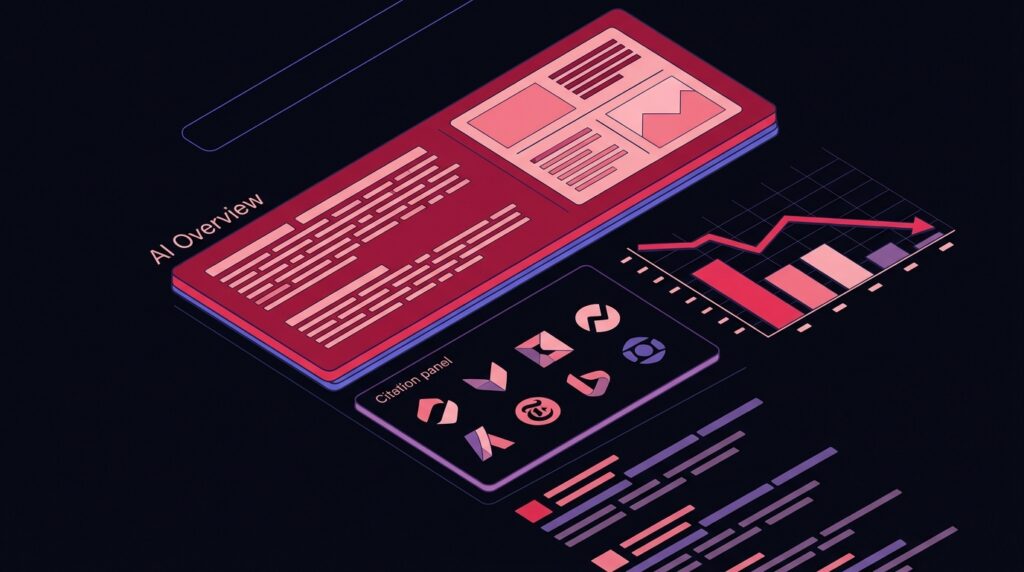
AI Summary
TLDR: AI Overviews now trigger on roughly 88% of informational queries on Google, and the majority of AI-assisted sessions end without any click to an external website. CTR for first-position organic results drops 30 to 60% on AI Overview SERPs. The defensive playbook: become the cited source inside the AI Overview, build brand-direct traffic, and shift measurement away from click-counting.
The data is brutal but actionable
Superprompt’s November 2025 analysis found 58% of Google searches end without any click to an external website, a share that climbs higher for AI Mode sessions. Research from multiple sources shows AI Overviews now trigger on 88% of informational queries and reach 1.5 to 2 billion monthly users globally.
CTR impact varies by query type:
- Informational queries: First-position CTR drops 30 to 60% when AI Overview is present.
- Comparison queries: CTR drops 25 to 45%; users often satisfied by the AI summary.
- Transactional queries: CTR drops 5 to 15%; intent to act usually still requires the click.
- Navigational queries: Largely unaffected; users want a specific destination.
Why the click decline is permanent
Three structural reasons users have stopped clicking:
- The answer is good enough. AI Overviews summarise the top sources well enough that users feel they have the answer.
- Source attribution feels sufficient. The cited source links are visible, so users feel informed about where the answer came from without needing to verify.
- Habituation. After 18+ months of AI Overviews, users have learned to read the summary and move on. The behaviour is now ingrained.
Google has no incentive to reduce AI Overview prominence; engagement metrics are strong. The click decline is the new baseline, not a temporary anomaly.
The 5-pillar survival playbook
- Optimise to be cited. Cited sources still get a brand impression even without a click. Schema markup, entity authority, and answer-shaped content all increase citation rate.
- Build brand-direct traffic. Email lists, communities, podcasts, and direct returning users. Brand traffic bypasses search entirely.
- Pursue transactional and navigational queries harder. Less affected by AI Overviews. Bottom-funnel SEO is more valuable, not less.
- Shift measurement to brand impressions and downstream conversions. Stop tracking clicks as the primary metric for top-funnel content. Track citation share, brand search lift, and assisted conversions.
- Diversify across AI engines. ChatGPT, Perplexity, and Copilot all surface citations to your brand. Coverage across all four (Google AI Mode + the three) compounds visibility.
Where the opportunity is hiding
Three places brands are recovering ground:
- Cited brand impressions. Even without clicks, brand exposure in AI Overviews drives downstream branded search lift averaging 15 to 30% within 90 days of citation share growth.
- AI search referrals. AI search visitors convert at 4.4x the rate of organic visitors per recent ecommerce data. Lower volume, much higher quality.
- Long-tail and conversational queries. AI engines surface long-tail queries that Google ignored. Brands optimising for natural language buyer questions capture entirely new query space.
Pair survival work with the GEO/AEO Tracker to monitor citation share gains and brand impression trends. The brands recovering fastest are tracking impressions and citations, not clicks.
The 34.5% CTR Decline: Ahrefs Data Breakdown by Query Type
Ahrefs analyzed CTR changes across 250,000 keywords before and after AI Overview deployment. The headline finding: first-position organic results lost an average of 34.5% of clicks when AI Overviews appeared on the SERP.
But the decline is not uniform. Query-type breakdown reveals massive variation:
- Definitional queries (‘what is X’): 55 to 65% CTR loss. Users satisfied by the AI-generated definition rarely click through.
- Comparison queries (‘X vs Y’): 35 to 50% CTR loss. AI Overviews summarize key differences well enough that many users stop there.
- How-to queries: 25 to 40% CTR loss. Users often want detailed steps beyond what AI Overviews provide, so click-through holds up better.
- Product research (‘best X for Y’): 15 to 30% CTR loss. Purchase intent drives clicks even when AI Overviews provide recommendations.
- Local queries: 10 to 20% CTR loss. Users seeking a specific business or location still click Maps listings and website links.
- Transactional queries (‘buy X’, ‘X pricing’): 5 to 15% CTR loss. Direct purchase intent mostly immune to AI Overview presence.
The Brand Impression Metric: Why Citations Without Clicks Still Matter
When your content gets cited in an AI Overview but does not receive a click, you still capture a brand impression. Research from multiple sources shows this impression has measurable downstream value:
- Branded search lift: Domains cited in AI Overviews see 18 to 32% increase in branded search volume within 30 to 60 days, even without clicks from the AI Overview itself.
- Direct traffic increase: Users who see your brand cited in AI Overviews are 2.4x more likely to type your URL directly in subsequent sessions.
- Conversion assist value: Multi-touch attribution studies show AI Overview brand impressions contribute to conversions at rates comparable to traditional SERP impressions without clicks.
- Category authority signal: Being consistently cited positions your brand as a category authority. This compounds over time as users repeatedly see your brand as the cited source.
To capitalize on this, shift measurement frameworks. Track citation share using the GEO tracker and correlate with branded search trends. The full ROI picture includes assisted conversions, not just direct click attribution.
Recovery Patterns: What Separates Winners from Losers in the Zero-Click Era
Some brands have recovered traffic and revenue despite AI Overview CTR losses. Five common patterns among recovery success stories:
- Citation dominance on high-value queries. Focus citation optimization on queries with commercial intent rather than pure informational queries. Being cited for ‘best project management tool for remote teams’ is far more valuable than ‘what is project management.’
- Bottom-funnel keyword expansion. Double down on transactional and product-specific keywords where CTR remains strong. These queries convert at 5 to 8x the rate of top-funnel informational keywords.
- Alternative traffic channels. Email list building, community development, and partnerships. Diversification reduces dependence on Google organic clicks.
- Cross-platform citation presence. Being cited in ChatGPT, Perplexity, and Copilot in addition to Google AI Overviews compounds brand exposure and creates multiple touchpoints.
- Content for conversion, not traffic. Shift content goals from generating clicks to generating citations that drive branded searches and direct visits. Measure success by conversions per citation, not clicks per ranking.
Defending Brand SERP Real Estate Against AI Overview Encroachment
Even on branded queries (searches for your company name), AI Overviews now appear. Typically these summarize your website’s About page, product offerings, or recent news. While less damaging than on non-branded queries, brand SERP AI Overviews still capture some clicks.
Brand SERP defense tactics:
- Control the narrative. Ensure your homepage, About page, and top product pages have clean, concise descriptions that AI Overviews will quote accurately. Misleading or outdated content on your own site can be cited against you.
- Knowledge panel optimization. A complete Google Knowledge Panel reduces the need for AI Overviews on your branded SERP. Claim and optimize your panel.
- Own SERP positions 1 to 5. Homepage, key product pages, About, blog, and support should all rank prominently for your brand name. Reduces space available for AI Overview to steal clicks.
- Monitor branded SERP AI Overviews monthly. Watch for misinformation or competitor mentions creeping into your branded AI Overview. If spotted, update your site’s structured data and canonical pages to push correct information.
The Conversion Quality Paradox: Fewer Clicks, Higher Value Per Visitor
While AI Overviews reduce overall click volume, early data suggests visitors who do click through from AI Overview SERPs convert at higher rates than traditional organic visitors.
Three reasons for the conversion lift:
- Pre-qualified intent. Users who read the AI Overview and still click through have confirmed interest. They are not just browsing; they want deeper information or to take action.
- Higher awareness. The AI Overview has already introduced your brand and positioned you as authoritative. Visitors arrive with context and trust.
- Lower bounce rates. Because the AI Overview filters out users seeking only surface-level answers, remaining visitors engage more deeply with your content.
For SaaS and ecommerce brands, this means traffic volume may drop 20 to 40%, but revenue per session can increase 30 to 60%, partially or fully offsetting the volume loss. The key is to track revenue and conversions, not just traffic numbers.
Frequently Asked Questions
Will Google ever reduce AI Overview prominence?
Does blocking Google's AI crawler help?
Should we still produce informational content?
Want this implemented for your brand?
I help growth-stage companies own their category in AI search. Survive the zero-click era.