TL;DR
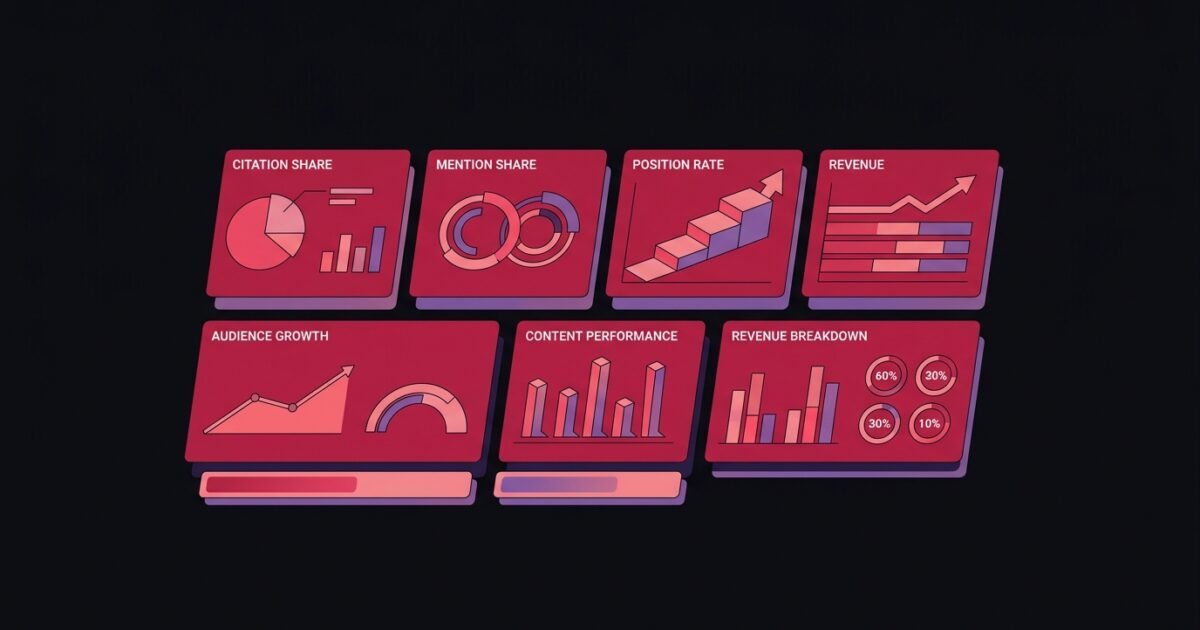
- The GEO KPI framework tracks six metrics at three cadences to link citation share to revenue.
- Our May 2026 study of 153,425 citations found 76.95% of cited URLs are NOT in the organic top 10.
- The six KPIs: citation share by category, velocity, position-1 rate, branded search lift correlation (R-squared above 0.6 at 4-6 weeks), AI referral conversion, and diversity.
- Practitioner targets: 2-5% citation share early, 8-15% growing, 20%+ at maturity, position-1 rate 8-15%, 200+ queries per quarter.
- Cadence: weekly citation ops review, monthly 6-KPI dashboard, quarterly revenue attribution.
- Revenue attribution lag-correlates citation share gains against branded search cohort volume.
The GEO KPI measurement framework sets the targets and reporting cadence that tell you whether your AI citation investment is compounding or stalling. Citation count alone is a vanity metric. Revenue-correlated GEO measurement requires six KPIs tracked at three different cadences, with maturity-stage targets and a quarterly revenue attribution model. Our May 2026 study of 153,425 citations across 6 AI engines found 76.95% of cited URLs are NOT in the organic top 10, which means your existing rank-tracking stack is measuring the wrong thing.
How this framework differs from the 7-metric instrumentation guide
The AI search analytics metrics post covers how to collect and compute each metric: which tools to use, how to instrument GA4, how to run prompt panels. This post covers the target-setting layer: what numbers to aim for at each maturity stage, how to structure reporting so leadership can act on it, and how to translate citation share gains into a revenue attribution number. Read both; they are complementary.
| Post 131: 7-metric instrumentation layer | This post (206): KPI targets and reporting cadence |
|---|---|
| How to collect each metric | What target to set per maturity stage |
| Which tools instrument which metric | How to structure weekly/monthly/quarterly reporting |
| How to build the prompt panel | How to calculate revenue attribution from citation share |
| Leading vs lagging signal classification | What to do when targets are missed |
The 6 GEO KPIs and what each predicts
We track six KPIs in our client GEO programs. Each captures a different failure mode. Running them together closes the gaps that any single metric leaves open.
1. Citation share by category
Percentage of tracked queries in a topic cluster where your domain appears in the AI answer. This is the primary leading indicator of brand visibility growth. Break it down by category, not just total: a brand can own one cluster and be invisible in two others where competitors are closing deals. Citation share is the lagging output; citation velocity is the leading input that predicts where citation share will be in 4-8 weeks.
2. Citation velocity
Rate of new query coverage: the percentage of your target query set that cited you this week but not in the prior four weeks. Velocity is the earliest signal of topical authority growth. A domain gaining citations faster month over month is in the compounding zone. A domain with stable citation share but slowing velocity is a plateau risk. We watch velocity first; citation share follows velocity by 4-8 weeks.
3. Position-1 citation rate
How often you are the first or only cited source in the answer. Position-1 citations carry the strongest brand encoding: the user reads your brand name before any competitor. In practice, position-1 rate below 5% means your citation share is soft and likely to be displaced when a competitor improves their content in that cluster.
4. Branded search lift correlation
Statistical correlation (R-squared) between weekly citation share growth and branded search volume at a 4-6 week lag, measured via Google Search Console. This is the most actionable proxy for proving AI visibility has downstream demand impact. R-squared above 0.6 at the 4-6 week lag is the threshold we use in client reporting to confirm that citation share is a meaningful driver rather than a coincidence. The share of voice vs search volume post covers the methodology for combining GSC and citation data.
5. AI referral conversion rate
Conversion rate of sessions arriving from AI platforms (ChatGPT, Perplexity, Gemini referrals) vs your blended baseline. Users arriving from AI assistants have already completed a research and recommendation phase before clicking, which compresses the consideration stage. Set up a custom channel group in GA4 with an AI source regex. The GA4 AI search referral attribution guide covers the exact regex and setup. Track conversion events and revenue per session month over month.
6. Citation diversity
Number of distinct queries where you appear cited, measured per quarter. Wide is more durable than narrow. A brand with 500 citations from 20 queries is one content update away from losing most of its visibility. A brand with 500 citations across 200 queries has structural resilience. Citation diversity also measures topical authority breadth: the number of distinct question contexts where AI engines consider you a credible source.

Maturity-stage targets: what to aim for and when
These targets come from our practitioner experience across B2B SaaS, professional services, and ecommerce GEO programs. They are not external benchmark data; treat them as directional estimates that your program will calibrate against as you build your own baseline. Every category and competitive set produces different absolute numbers; the pattern of progression across stages is more reliable than any single target value.
| KPI | Early stage (months 1-3) | Growth stage (months 4-9) | Mature stage (months 10+) |
|---|---|---|---|
| Citation share (primary category) | 2-5% | 8-15% | 20%+ |
| Citation velocity (new citations/week) | 1-3% of query set | 2-5% of query set | 0.5-2% (dominance maintenance) |
| Position-1 citation rate | Not tracked yet | 5-10% of citations | 8-15% of citations |
| Branded search lift lag correlation (R-squared) | Baseline only | 0.4+ at 6 weeks | 0.6+ at 4-6 weeks |
| AI referral conversion vs blended baseline | Baseline only | 1.5-2x | 2x or higher |
| Citation diversity (distinct queries/quarter) | 20-50 | 80-150 | 200+ |
Early stage brands should not chase the mature-stage targets. A month-1 brand aiming for 20% citation share will spread content investment too thin to build the topical depth that drives compounding. Build from 2-5% citation share in a single primary category before expanding. The AI brand visibility tracking metrics post covers how to baseline before setting targets.
Reporting cadence: three layers, three audiences
The single biggest operational failure in GEO measurement is collapsing all data into one monthly report. Different metrics move at different speeds and serve different decision-makers. We structure reporting in three distinct layers.
Weekly: citation operations layer
Audience: the practitioner running the GEO program. Metrics: citation share by category, citation velocity, top citation wins and losses this week. Format: 15-minute internal review using the GEO/AEO Tracker output. Decision trigger: velocity dropping for two consecutive weeks in a cluster signals a content gap or technical crawl issue. Act before it shows up in monthly citation share.
Monthly: performance layer
Audience: marketing director and growth leadership. Metrics: all 6 KPIs with month-over-month trend, branded search correlation update, AI referral conversion comparison. Format: dashboard in Looker Studio or equivalent with one-page executive summary. Decision trigger: branded search R-squared below 0.4 for two months means citation activity is not translating to brand demand. Audit citation quality and context before scaling volume.
Quarterly: revenue attribution layer
Audience: CFO and revenue leadership. Metrics: citation-driven revenue model refresh, competitive benchmarking, citation share vs revenue target reconciliation. Format: half-day workshop with the methodology documented and version-controlled. Decision trigger: this is where you reset targets for the next quarter based on observed velocity, competitive shifts, and revenue attribution results.
The quarterly revenue attribution model
Direct attribution from AI citation to conversion is impossible: AI engines do not pass referrer data for zero-click impressions. The solution is a statistical cohort model that quantifies what portion of branded search and direct traffic lift is plausibly driven by citation share gains.
- Define cohorts by entry channel and week. Segment users by entry channel (branded search, direct, non-branded organic, paid) and the week they first entered.
- Overlay citation share growth. Plot weekly citation share alongside each cohort’s entry volume. Measure R-squared at 4, 6, and 8 week lags.
- Isolate the lift above baseline. For cohorts entering 6 weeks after a citation share gain, calculate volume above the pre-gain baseline. This lift volume is the AI-attributed entry estimate.
- Apply conversion and revenue multipliers. Multiply lift volume by cohort-specific conversion rate and average order value. This produces a quarterly AI-attributed revenue estimate.
- Sanity-check against the dark funnel. A portion of AI-influenced demand arrives via direct or branded search with no identifiable trigger event. Your attribution estimate is a floor, not a ceiling.
Example: citation share grew 8 percentage points in a cluster during Q1. Six weeks later, branded search entries in that cluster increased 11% above baseline, with a correlation R-squared of 0.68. Those 11% additional branded entries converted at 3.8% with an average order value of $2,800. That is the basis of the AI-attributed revenue calculation for Q1. The GEO ROI and AI traffic revenue post covers the full financial model.
Diagnostic protocol: what to do when a KPI misses target
Missed targets are signals, not failures, if you have the diagnostic protocol to read them. Each KPI failure mode maps to a different root cause.
- Citation share flat, velocity slow: topical depth problem. The content cluster lacks breadth. Add coverage for underserved queries in the category before optimising existing pages.
- Citation share growing, branded search R-squared below 0.4: citation quality problem. You are being cited in low-relevance or negative contexts. Audit the surrounding answer text for each citation and address the framing.
- Citation share high, AI referral conversion below baseline: landing page problem. Citation traffic lands on editorial pages without a clear commercial path. Fix interlinking from high-citation pages to service pages.
- Position-1 rate below 5% despite good citation share: authority depth problem. You are cited as a secondary source. Strengthen your primary category claims with original data and named frameworks. The co-citation analysis post covers how to identify which sources are being cited ahead of you.
- Citation diversity stalling: content expansion problem. You have saturated your initial cluster. Map adjacent query spaces and begin coverage there. The DIY AI brand visibility audit gives a structured framework for identifying the expansion opportunities.
Tool stack for this framework
The full measurement stack does not require seven separate subscriptions. Most data comes from three sources.
- Prompt panel runner: the open-source GEO/AEO Tracker covers citation share, velocity, position-1 rate, and citation diversity from a single weekly query run across 6 AI engines.
- Analytics platform: GA4 with a custom AI channel group for referral conversion tracking. The GA4 referral attribution guide covers setup end to end.
- Dashboard layer: Looker Studio connected to GEO/AEO Tracker CSV exports and GA4 for the monthly performance layer.
- Revenue attribution: Python or Google Sheets for the quarterly lag-correlation model. The calculation is reproducible with basic statistical functions once the cohort data is structured.
- GEO audit baseline: before setting targets, run a GEO audit to establish current citation share across your primary clusters. You cannot set meaningful targets without a verified baseline.
The GEO primer covers foundational concepts for teams new to generative engine optimization. For the instrumentation how-to behind each metric in this framework, the AI search analytics metrics post is the companion read.
The right platform tracks most of these KPIs for you. See which GEO tool fits your team.