TL;DR
- HowTo rich results were deprecated in September 2023.
- FAQ rich results were removed entirely by Google on May 7, 2026.
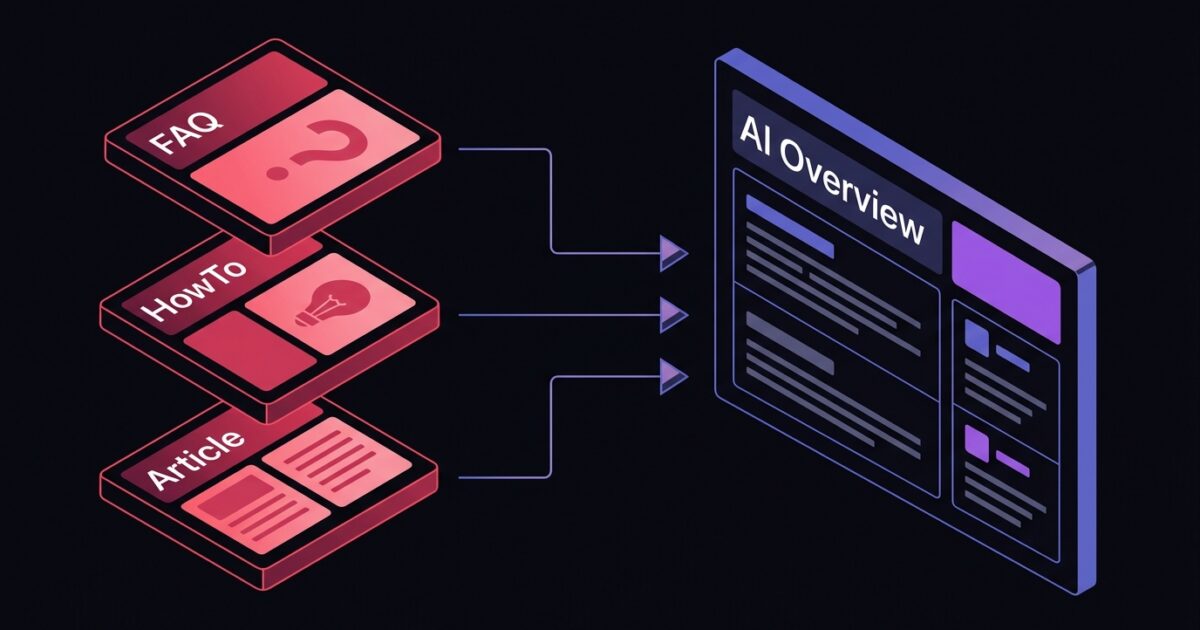
- Both schema types retain semantic value for AI engines: FAQPage maps question-answer structure for AI retrieval, HowTo signals step structure for instructional queries, and Article schema is the mandatory baseline for every content page.
- Stacking schema types gives AI engines a complete semantic map of page structure and entity relationships.
- The seven critical Article properties are headline, datePublished, dateModified, author (Person schema with sameAs), publisher (Organization with logo), image, and description.
- Invalid schema reduces citation eligibility; validate with Google Rich Results Test before deployment.
- Comprehensive schema rollout supports AI citation eligibility, though the timeline varies by site.
Schema markup tells AI engines exactly what your content is and how to use it. FAQPage, HowTo, and Article are the three schema types that most directly affect AI citation eligibility in 2026, but each has a different function and a different deployment context. This guide covers which schema to use, when to layer them, and the structural requirements that determine whether AI engines read your markup or ignore it.
What changed: HowTo and FAQ rich results are gone
In August 2023, Google announced it was reducing the visibility of FAQ rich results and limiting HowTo rich results to desktop only. By September 2023, Google confirmed HowTo rich results were fully deprecated across both mobile and desktop. As of May 7, 2026, FAQ rich results are no longer appearing in Google Search at all, as confirmed in the Google Search Central changelog.
This matters for your strategy in two ways. First, the direct SERP benefit (the expandable Q&A boxes) is gone. Second, the semantic benefit remains: schema markup still provides AI engines with explicit structured understanding of your content, which affects citation eligibility in AI Overviews, ChatGPT, Perplexity, and Gemini. FAQPage and HowTo schema are still worth implementing for their semantic signal, not for rich result appearance.
HowTo rich results were deprecated in September 2023. FAQ rich results were removed entirely as of May 7, 2026. Both schema types retain semantic value for AI engines despite losing their SERP appearance.
Article schema: the mandatory baseline
Article schema (and its variants BlogPosting and TechArticle) is the required foundation for any blog post, guide, or resource page. In our GEO work with B2B SaaS clients, we find that missing or incomplete Article schema is the single most common structured data error blocking citation eligibility.
Google Search Central notes that for Article schema, recommended properties include headline, datePublished, dateModified, author, and image. Publisher is not on Google’s recommended list, but we still populate it. We treat all of these as required in practice because incomplete Article schema reduces citation likelihood compared to complete markup. The seven properties that matter most for AI engines:
- headline: Must match the H1 exactly. Mismatches between headline and H1 confuse entity extraction.
- datePublished: Original publication date in ISO 8601 format.
- dateModified: Last substantive update. AI engines weight this for freshness scoring. Update on content changes, not typo fixes.
- author: Person schema with name, url, and sameAs links (LinkedIn, company bio page). Real human attribution drives E-E-A-T signals.
- publisher: Organization schema with name and logo (ImageObject with url, width, height).
- image: Hero image URL. Many AI engines use this as a secondary verification signal.
- description: 100-160 character summary. This often becomes the snippet AI engines surface.
The choice of Article subtype matters. Use BlogPosting for general editorial content, TechArticle for developer-facing documentation, and NewsArticle for time-sensitive coverage. The subtype signals content category to AI engines during retrieval. See the JSON-LD vs Microdata comparison for implementation format guidance, but JSON-LD in a script tag is the recommended approach for all Article schema.

FAQPage schema: semantic value without the SERP display
FAQPage schema is still worth implementing in 2026, but for a different reason than it was two years ago. The schema gives AI engines a directly structured question-answer map of your content. When an AI engine is deciding which passage to cite in response to a question-shaped query, a page with explicit FAQPage markup reduces ambiguity about what the page answers.
Our editorial guidelines for FAQ content on FAQ vs HowTo schema decisions treat the following as working standards (not external citations):
- Use FAQPage when the page contains 3 or more distinct question-answer pairs that mirror real user queries.
- Each answer should be self-contained: it should make sense without reading surrounding page content. AI engines extract FAQ items in isolation.
- Question phrasing must match how users actually ask. Use exact phrasing from Search Console queries, support tickets, or sales call recordings.
- We recommend 4-10 FAQ items per page. Below 3 items the semantic signal is weak. Above 12 items, the questions should probably become separate sections with their own schema.
- Answers in the 50-150 word range perform well. Under 30 words reads as thin. Over 200 words should be its own content section.
The FAQPage schema goes in the JSON-LD script block alongside Article schema. Do not add a visible FAQ section to the page content itself; the schema is sufficient for AI engine parsing. We place FAQs in ACF fields that render the JSON-LD automatically, keeping the visible page clean while preserving the structured signal.
FAQPage schema no longer produces SERP rich results. Its value in 2026 is purely semantic: it reduces AI engine ambiguity about which questions your page answers.
HowTo schema: match schema to procedure structure
HowTo schema is the citation driver for instructional queries. Atomic-sentence optimization is effective for declarative content, but for procedural content where users need ordered steps, HowTo schema signals the structure directly. Use HowTo schema when:
- The page describes a procedure with 3 or more ordered steps.
- Each step has a specific, actionable instruction with a clear action verb.
- The procedure has a defined outcome: the user accomplishes X by completing the steps.
- The content is stable: procedures that change frequently lose schema value quickly if markup lags.
HowTo schema has optional but valuable properties. The totalTime property (using ISO 8601 duration format, e.g., PT30M for 30 minutes) signals procedural completeness to AI engines. Step-level image properties can improve citation rates for procedural queries where visual confirmation matters. The tool and supply properties list prerequisites.
The 3-to-12 step range is our operational guideline. Below 3 steps the content is too simple to need HowTo schema. Above 12 steps, the procedure should be broken into phases or sub-procedures, each potentially with its own HowTo schema. We have never seen AI engines cite HowTo-marked pages worse than equivalent unmarked pages, so there is no downside to implementing it correctly on eligible content.
Schema stacking: the compound coverage approach
The highest-cited pages in our client work layer multiple schema types. The combination is not schema spam: each type describes a different aspect of the page. When layered correctly, AI engines get complete semantic understanding of content type, structure, and entity relationships.
| Schema Type | Use When | Primary Benefit |
|---|---|---|
| Article / BlogPosting | Every content page | Establishes content type and freshness signals |
| FAQPage | Page has 3+ distinct Q&A pairs | Maps question-answer structure for AI retrieval |
| HowTo | Page describes an ordered procedure | Signals step structure for instructional queries |
| Person (author) | Any attributed content | Drives E-E-A-T and author entity recognition |
| Organization (publisher) | Site-wide | Establishes entity ownership and brand recognition |
| BreadcrumbList | Any page with category hierarchy | Provides navigation context for entity extraction |
The stacking pattern for a typical technical blog post: Article (BlogPosting) as page baseline, Person schema for the author embedded in the author property, Organization schema in the publisher property, FAQPage if there is a Q&A section, and HowTo if the post contains a setup procedure. The sameAs property on Person and Organization schema connects entities to their authoritative sources, which is increasingly important as AI engines cross-reference entity mentions across the web.
For E-E-A-T signals in AI search, the author Person schema is the most directly impactful addition after Article baseline. AI engines that evaluate author expertise look for name, url, and sameAs links to professional profiles. An author schema referencing a LinkedIn profile with verifiable credentials outperforms a generic ‘Admin’ or ‘Editorial Team’ attribution.
Stack schema types to give AI engines a complete semantic map of your page. Article is baseline, FAQPage and HowTo add structural specificity, and Person schema drives author authority signals.
JSON-LD implementation template
{
  "@context": "https://schema.org",
  "@graph": [
    {
      "@type": "BlogPosting",
      "headline": "Your Article Title Here",
      "datePublished": "2026-01-15",
      "dateModified": "2026-06-01",
      "author": {
        "@type": "Person",
        "name": "Author Full Name",
        "url": "https://example.com/author/",
        "sameAs": ["https://linkedin.com/in/author-handle/"]
      },
      "publisher": {
        "@type": "Organization",
        "name": "Company Name",
        "logo": {
          "@type": "ImageObject",
          "url": "https://example.com/logo.png",
          "width": 200,
          "height": 60
        }
      },
      "image": "https://example.com/post-hero.jpg",
      "description": "100-160 character summary goes here for AI snippet targeting."
    },
    {
      "@type": "FAQPage",
      "mainEntity": [
        {
          "@type": "Question",
          "name": "What is the question exactly as users ask it?",
          "acceptedAnswer": {
            "@type": "Answer",
            "text": "The answer: self-contained, 50-150 words, no references to other FAQs."
          }
        }
      ]
    }
  ]
}
Place this JSON-LD in a script tag in the page head or within the body. Using @graph allows multiple schema types in a single block, keeping the markup clean and reducing parser overhead. The HTML5 semantic tags guide covers how to complement schema with semantic HTML for maximum AI extraction accuracy.
Validation and deployment workflow
Invalid schema is worse than no schema. It can signal low content quality and reduce citation eligibility on pages where the schema errors occur. Our validation workflow before any schema deployment:
- Write schema from official examples. Start with schema.org templates and adapt. Do not write from scratch.
- Validate with Google Rich Results Test. Fix all errors. Warnings on deprecated rich result types (FAQ, HowTo) can be noted but do not block deployment.
- Cross-validate with Schema.org validator. Google’s tool catches Google-specific issues; the schema.org validator catches spec compliance issues that other AI engines also enforce.
- Deploy to staging first. Test in a non-production environment before pushing to live pages.
- Monitor Search Console post-deployment. Schema errors surface in the Enhancements section. Check weekly for the first month after any schema rollout.
- Re-validate after CMS or theme updates. Plugin or theme updates can silently break schema output. Re-test after major site changes.
Track schema impact using the GEO audit service: citation eligibility improves over time after comprehensive schema deployment, with the exact timeline varying by site. The GEO audit checklist covers schema as one of 50 points, which puts it in context: structured data is a prerequisite, not a substitute for content quality and trust signals.
Common schema mistakes that block citation eligibility
In our client work auditing schema implementations, five mistakes recur that eliminate schema citation value:
- Headline mismatch. The Article headline property does not match the H1. AI engines cannot reconcile the mismatch and may ignore the schema entirely.
- Stale dateModified. Content was updated but dateModified still shows the original publication date. AI engines treat the page as older than it is, reducing freshness scores.
- Generic author attribution. Author is set to ‘Admin’ or ‘Editorial Team’ instead of a real person with a Person schema entity. Generic attribution removes E-E-A-T signals.
- Missing logo in Organization schema. The logo ImageObject is required for publisher entity recognition. Missing or broken logo URLs leave the publisher entity incomplete.
- Promotional FAQ content. FAQ items that are marketing copy (‘Why is our product the best?’) get filtered by AI engines as low-quality. FAQs must be genuinely informational questions users actually ask.
Audit existing schema on your highest-traffic pages first. Fixing errors on pages that already receive significant impressions delivers faster measurable impact than adding schema to low-traffic pages. Use internal linking to pass authority from your best-schema pages to related content within the cluster.