TL;DR
- The schema.org sameAs property links your entity to authoritative external profiles so AI engines can confirm identity; it runs on 10M+ domains per Google's web index.
- Entity resolution runs before retrieval: brands that fail it are excluded before passage scoring.
- In our May 2026 study of 153,425 citations, 76.95% of cited URLs sat outside the organic top-10, so entity beats rank.
- Priority for Organization sameAs: Wikidata (direct KG feed, Q-number as identifier), Wikipedia, LinkedIn (2,267 citations across 988 queries in that study), Crunchbase, GitHub.
- Three properties must match across every profile: name, canonical URL, and description.
- A broken sameAs link is worse than no link.
- Validate with Schema Markup Validator and run direct AI prompt tests at 30-60-90 days.
The sameAs property in schema.org is a URL field that tells AI engines and search crawlers: this page and that external profile both describe the same entity. It is the primary mechanism for entity disambiguation in structured data, and it is the difference between an AI engine that confidently cites your brand and one that skips you because it cannot tell you apart from three other companies with similar names.
Why AI Engines Need Explicit Disambiguation
Every AI engine builds an internal entity graph: a map of which named things in its training data and live-retrieval index refer to the same real-world entity. When a user asks about a product category, the engine resolves every brand it considers mentioning against that graph before retrieving any content. Brands that cannot be confidently resolved are excluded before the retrieval pass begins, regardless of how well their pages rank or how much content they publish.
This is acute for brands with common-word names (Apex, Pivot, Nova), names that overlap with a film or band, or personal-brand consultancies sharing a name with other practitioners. But it applies at scale to every brand. Our May 2026 study of 153,425 AI citations found that 76.95% of cited URLs were not in the organic top-10 for their query. Entity recognition gates citation eligibility before ranking matters. A brand that fails entity resolution is excluded from that pool entirely.
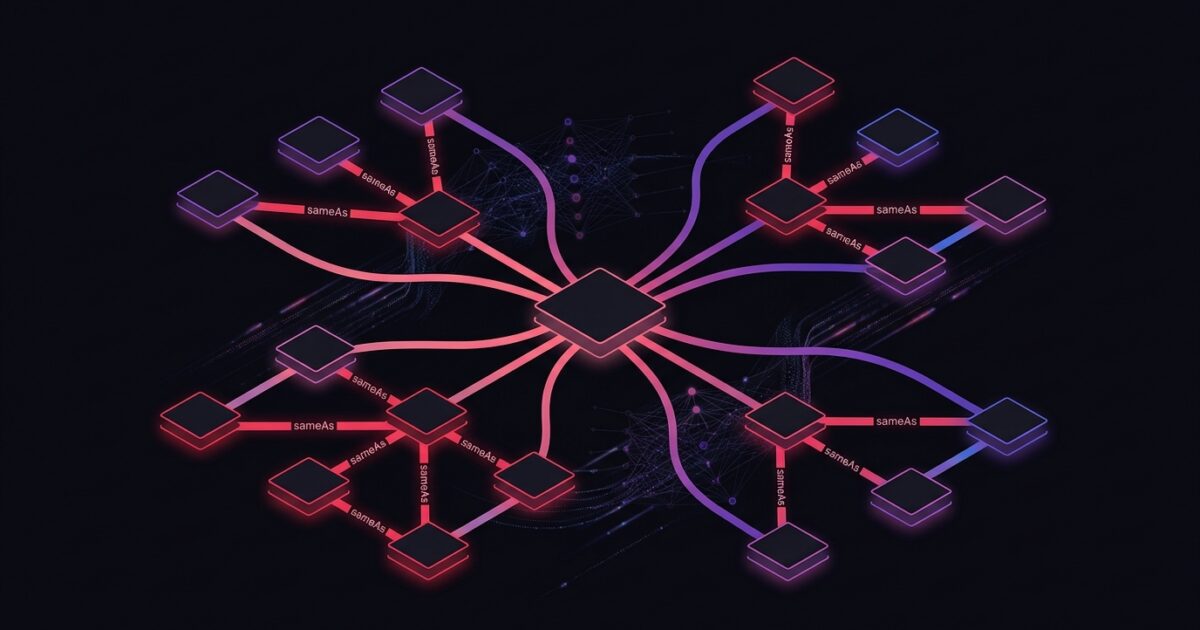
Strong sameAs markup moves your brand from “probably this company” to “definitely this company” in the engine’s confidence model. It does this by linking your website entity to profiles on sources the engine already trusts: Wikidata, LinkedIn, Crunchbase, GitHub. Each link is a merge instruction: consolidate this profile and my website into one confirmed entity node. The more authoritative the source, the stronger the merge signal.
Entity resolution happens before content retrieval. Brands that fail it are excluded before passage scoring begins, regardless of ranking position or content quality.
What schema.org/sameAs Actually Does
The schema.org specification defines sameAs as: “URL of a reference Web page that unambiguously indicates the item’s identity. E.g. the URL of the item’s Wikipedia page, Wikidata entry, or official website.” It is a property of the Thing type, which means it applies to Organizations, Persons, Places, Products, and every other schema.org entity type. It is used on millions of domains across the web.
In practice: you deploy sameAs inside a JSON-LD Organization or Person block as an array of URLs. Each URL points to the entity’s profile on an authoritative external site. The AI engine’s retrieval bot follows those URLs, checks that the profile describes the same entity as your canonical domain, and uses that confirmation to attribute citations correctly. This is the same mechanism Google uses to merge records into the Knowledge Graph.
{
  "@context": "https://schema.org",
  "@type": "Organization",
  "name": "Your Brand Name",
  "url": "https://yourdomain.com",
  "description": "One sentence matching your Wikidata description exactly.",
  "sameAs": [
    "https://www.wikidata.org/wiki/Q[your-Q-number]",
    "https://www.linkedin.com/company/your-brand",
    "https://www.crunchbase.com/organization/your-brand",
    "https://github.com/your-brand"
  ]
}
Which Profiles to Link and Why
Not all sameAs targets carry equal weight for entity resolution. Based on our brand entity optimization work across client accounts, here is the priority order for Organization entities:
| Profile | Weight | Key requirement |
|---|---|---|
| Wikidata | Highest: direct feed into Google Knowledge Graph; Q-number used as entity identifier | Label must match Organization schema name exactly; official website property set |
| Wikipedia | Very high when present; AI training corpora weight Wikipedia heavily | Notability criteria must be met; most B2B brands should start with Wikidata |
| LinkedIn company page | High; in our May 2026 study LinkedIn appeared 2,267 times across 988 queries | Company name, founding year, and URL matching your schema; description consistent with Wikidata |
| Crunchbase | High; structured business data source Google crawls for entity enrichment | Complete funding and founder data; canonical URL matching domain |
| GitHub organization | Medium; critical for SaaS and technical brands | Organization account with bio containing canonical URL |
| Official social profiles | Lower; useful for redundancy | Active profiles only; bio must match schema name exactly |
The data from our May 2026 citation study (153,425 citations, 6 AI platforms) showed Wikipedia cited 1,483 times. That citation frequency is partly driven by Wikipedia’s own content quality, but it also reflects that AI engines treat Wikipedia as a high-confidence entity source when they are resolving brand identities at query time.
sameAs for Person Entities: Author Disambiguation
sameAs applies to author entities as well as brand entities. A consultant with a common name needs Person schema with sameAs links to LinkedIn, ORCID (for academic or medical authors), Wikidata (if an entry exists), and Twitter/X. The author entity guide covers the full implementation. The mechanism is the same as for organizations: each sameAs URL is a corroboration point the engine checks to confirm identity before attributing citations to that author’s content.
Our May 2026 citation study found that pages with named, schema-attributed authors whose entity records resolve perform better in AI retrieval than pages with generic bylines. Entity resolution for authors is not separate from entity resolution for brands: the Person entity links to the Organization entity via the worksFor property, and the Organization entity references the founder or key persons via the founder property. Both layers must be present and cross-referencing each other for the entity graph to be fully connected.
The Knowledge Graph Connection
Google’s Knowledge Graph holds over 500 billion facts about five billion entities, drawing from hundreds of web sources and open databases. When your website schema, Wikidata item, LinkedIn page, and Crunchbase profile all declare the same canonical name and URL, Google consolidates them into a single reinforced entity node. When they conflict even on minor details, like “Inc.” versus “Inc” or a trailing slash versus none, the engine reduces confidence and may never fully consolidate the record.
The Knowledge Graph entity authority guide covers the full entity architecture. The sameAs property is the merge instruction: it tells the engine which external profiles to include in the merge. The entity itself is established by the consistency of facts across those profiles. Three properties must be identical everywhere: name, canonical URL, and description. Every other property adds signal strength, but inconsistency in these three blocks the merge.
The Wikidata entity guide covers creating and maintaining your Q-number entry. Wikidata is the single highest-impact sameAs target because it is a direct data feed into Google’s Knowledge Graph: a Wikidata entry with an official website property set and a consistent label is the fastest path to a confirmed entity node.
Three properties must be identical across every sameAs profile: name, canonical URL, and description. A single character difference prevents the entity merge.
Common sameAs Mistakes That Break Entity Recognition
Six failures that appear repeatedly in entity SEO audits:
- Dead or redirected sameAs URLs. A link to a deleted or redirected profile signals an entity that was once resolvable and no longer is. This is worse than no sameAs link. Audit all sameAs targets quarterly; LinkedIn occasionally changes profile URL formats.
- Mismatched name strings. “Acme Corp” in schema, “Acme Corp.” on LinkedIn, and “ACME” on Wikidata are three different entity nodes from the Knowledge Graph’s perspective. Pick one canonical name string and enforce it everywhere.
- HTTP instead of HTTPS. Mixed protocols break entity matching in some parsers. Always use HTTPS canonical URLs in the sameAs array.
- sameAs only on the homepage. The Organization schema with sameAs belongs on every page that emits an Organization or Person reference, including blog post author bylines. Embedding it only on the homepage means most of your content cannot benefit from entity resolution.
- Founder’s LinkedIn in the Organization block. The founder’s personal LinkedIn profile does not belong in the Organization sameAs array. Use a separate Person block linked via the
founderproperty. - Unclaimed profiles. An unverified or unclaimed Wikidata or Crunchbase profile carries weaker signal than a claimed and maintained one. Spend the hour to claim each target you include in the sameAs array.
How sameAs Fits Into the Full Entity Stack
sameAs is one layer of a stacked entity signal architecture. The Organization entity establishes your brand in the graph. The Person entity ties named authors to that organization. Article schema markup on each post attributes content to the Person. All three must be present and cross-referencing each other for AI citation to be consistent rather than occasional.
Local businesses benefit from the same treatment with an additional layer: Google Business Profile linkage as a sameAs target. AI Search and Google Maps both converge on entity recognition. Solving disambiguation once through consistent schema and sameAs declarations helps both channels.
For multi-brand companies, the rule is one Organization entity per legal brand with its own sameAs cluster, all connected via parentOrganization or subOrganization properties. Skipping the entity hierarchy causes cross-brand citation confusion: AI engines end up attributing parent-company achievements to a subsidiary brand or vice versa.
Validating and Testing Your sameAs Implementation
Validation has two layers: structural and behavioral. Run both after deployment.
- Schema Markup Validator (validator.schema.org): confirms your JSON-LD is valid and sameAs URLs resolve without redirects or errors. A single JSON syntax error silently invalidates the entire block with no visible page error.
- Google Rich Results Test: verifies Google’s parser accepts your structured data. Run after any schema change.
- Wikidata Query Service: confirm your Q-number resolves correctly and includes the official website property pointing to your canonical domain.
- Direct AI prompt testing: ask ChatGPT, Perplexity, Claude, and Gemini direct questions about your brand. Check for correct attribution, accurate descriptions, and links to your owned profiles. Run weekly for the first month after deployment, then monthly. Use our open-source GEO/AEO Tracker to automate this across all six platforms.
- sameAs URL audit: programmatically check every URL in your sameAs array returns HTTP 200 with no redirect chain. A broken sameAs link is worse than no link. Automate this check quarterly.
Set a 30-60-90 day verification cadence after deployment. At 30 days confirm schema parses cleanly and all external profiles resolve. At 60 days run direct AI prompt tests and log attribution accuracy. At 90 days compare brand citation rate against your pre-deployment baseline using the GEO audit checklist as a framework. If the lift is below 15% on at least two platforms, audit your sameAs targets for authority and reciprocity issues first, then check name consistency across all profiles.
Entity resolution enables content retrieval. Content retrieval produces citations. Citations in external sources that are themselves confirmed Knowledge Graph nodes feed back into the graph as corroborating mentions. Brands that establish a confirmed entity record early compound this loop faster than late adopters. The FAQ and HowTo schema guide and the review schema guide cover the content-layer schema that builds on top of the entity foundation sameAs creates.