TL;DR
- Google's Knowledge Graph resolves brands to entity nodes before any content retrieval.
- In our May 2026 study of 153,425 AI citations, 76.95% of cited URLs were outside the organic top-10, confirming entity recognition outweighs keyword ranking.
- The Google Knowledge Graph Search API uses schema.org types and JSON-LD to identify entities.
- Schema.org Organization is deployed on 10M+ domains per Google's May 2026 index data.
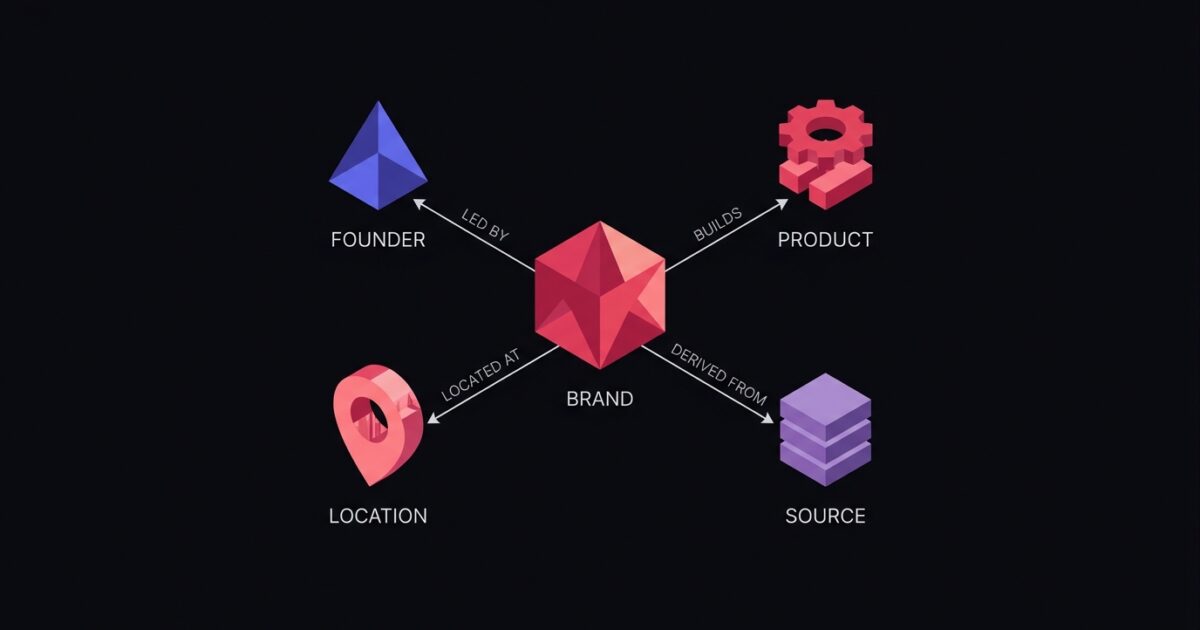
- Wikidata entries carry Q-number identifiers that feed directly into Google's entity merge pipeline. sameAs declarations across LinkedIn, Crunchbase, Wikidata, and GitHub trigger entity node consolidation.
- Brands without a Wikidata entry and complete Organization schema face structural exclusion from AI citation pools.
- The arXiv GEO study found rank-5 sites gained 115.1% AI visibility through entity and citation-signal optimization.
Entity authority determines whether AI engines recognise your brand as a citable source before they ever read your content. Google’s Knowledge Graph stores entities as structured nodes, and AI retrieval systems resolve query terms against those nodes first. Brands without a confirmed Knowledge Graph entry are screened out at the resolution step, before passage scoring begins.
In our analysis of 153,425 AI citations, 76.95% of cited URLs were not in the organic top-10 for the query. That number tells a clear story: entity recognition determines citation eligibility, not keyword ranking alone. AI engines draw from a structured knowledge layer that sits underneath keyword relevance, and the brands that dominate that layer get cited at a disproportionate rate.
What the Google Knowledge Graph Search API tells us about entity resolution
The Google Knowledge Graph Search API is a publicly available endpoint that lets you query the same entity graph Google uses for AI Overviews and featured results. The API uses standard schema.org types and returns JSON-LD responses. Three things become immediately clear when you use it as a diagnostic tool.
- Entities are typed. The API classifies your brand as an Organization, Person, LocalBusiness, SoftwareApplication, or similar schema.org type. Mismatched or absent type signals cause resolution failures.
- Entities have identifiers. A Knowledge Graph entity carries a unique MID (machine ID). Without one, the brand does not exist in the graph as a distinct node. Wikidata Q-numbers, Google Business Profile IDs, and Freebase remnants all feed into MID assignment.
- Entities link to external sources. The sameAs property is how the graph aggregates corroborating records. If your Organization schema, Wikidata entry, LinkedIn company page, and Crunchbase profile all declare the same canonical name and URL, Google merges them into a single, reinforced entity node.
We run entity visibility checks for clients using the Knowledge Graph Search API as the first diagnostic step. A brand that returns zero results or returns a low-confidence match is at structural risk of being excluded from AI-generated answers, regardless of content quality or backlink profile.
What entity authority actually means for AI citation
Entity authority is a resolution confidence level. When a user asks an AI engine “what does [Brand] do?” or references your category, the engine runs an entity resolution pass before retrieving any passages. High entity authority means the engine resolves your brand to a specific, typed node with corroborating signals. Low entity authority means the engine either fails to resolve you or resolves you to a low-confidence generic cluster.
The resolution output feeds directly into what we call the entity citation loop: resolved entity leads to passage retrieval, passage retrieval leads to citation, citation strengthens the entity signal across platforms. Brands that break into this loop early compound their advantage. Brands that skip entity infrastructure spend marketing budget on content that never enters the retrieval pool.
Entity resolution happens before content scoring. A brand without a confirmed Knowledge Graph entry is invisible to AI retrieval regardless of content quality.
The entity home page: your canonical anchor
Every entity needs a home page that functions as the canonical reference point for all other signals. This is typically your About page or homepage, but it must carry a complete Organization (or Person) schema block in JSON-LD. The schema block must include:
- name matching your Wikidata label exactly.
- url pointing to the canonical domain.
- sameAs array listing your LinkedIn, Crunchbase, X, GitHub, and Wikidata entity URL.
- foundingDate, foundingLocation, and description matching external profiles verbatim.
- founder referencing Person schema nodes for key individuals.
Schema.org Organization is the most widely deployed entity-signal schema type on the web. The gap between brands that deploy it correctly and brands that deploy it incompletely is large. Correct means all sameAs targets resolve, all external profiles carry matching name and URL data, and the schema validates without errors in the Schema Markup Validator.
sameAs strategy: connecting the entity graph
The sameAs property in schema.org declares that two URIs identify the same entity. In practice, every sameAs declaration you make is an instruction to Google’s Knowledge Graph merge process: “this profile is the same brand as this domain.” The AI engine can then aggregate statements from multiple authoritative sources into a single entity record.
Priority sameAs targets, ranked by entity graph weight:
| Profile | Why it matters | Key requirement |
|---|---|---|
| Wikidata | Direct feed into Google Knowledge Graph; Q-number used as entity identifier | English label must match your Organization schema name exactly |
| LinkedIn Company Page | Our May 2026 study (153,425 citations): LinkedIn is the 5th most-cited domain with 2,267 citations across 988 queries | Company name, founding year, and URL matching your schema |
| Crunchbase | Structured business data source; Google crawls it for entity enrichment | Complete funding, product, and founder data |
| Wikipedia | Highest-trust source for entity corroboration; our May 2026 study of 153,425 citations: 1,483 citations | Notability criteria met; internal Wikipedia links to other relevant entities |
| GitHub Organization | Signals technical credibility; important for SaaS and dev tool brands | Organization account (not personal), filled bio with canonical URL |
Each sameAs target you add reduces entity ambiguity. A brand named “Acme” with one website and no external profiles is nearly unresolvable. The same brand with a Wikidata entry, a complete LinkedIn company page, a Crunchbase profile, and consistent schema markup becomes trivially resolvable. For more on the Wikipedia component of this strategy, we have a full playbook.

Wikidata: the open registry AI engines trust most
Wikidata is a free, collaborative, multilingual secondary knowledge base that collects structured data to provide support for Wikipedia and other Wikimedia projects. Each entity in Wikidata carries a unique Q-number identifier, a label, a description, and a set of statements. Those statements include properties like official website, founded by, headquarters location, and industry, each linked to other entities via P-number properties.
For brands pursuing Knowledge Panel presence and AI citation eligibility, Wikidata is the highest-impact single action. Google’s Knowledge Graph ingests Wikidata statements directly. A Wikidata entry with a confirmed Q-number, matching official website, and at least three corroborating external IDs (LinkedIn, Crunchbase, ISNI) gives Google unambiguous resolution data. Without a Wikidata entry, a brand depends entirely on Google’s own scraping and inference, which is slower and less reliable.
Wikidata notability requirements for organizations are lower than Wikipedia’s. If your brand has a public website, is mentioned in at least one independent source, and has a distinct identity, it is likely eligible for a Wikidata entry. The entry must be maintained: stale data (wrong founding date, removed CEO) degrades entity confidence over time.
Organization and Person schema: the machine-readable identity layer
Organization and Person schema are the on-page declarations that tie your content to your entity record. They are entity identifiers that tell the AI engine’s retrieval layer which entity to associate with a given URL.
A complete Organization schema block for an AI-search-ready brand includes at minimum:
{
  "@context": "https://schema.org",
  "@type": "Organization",
  "name": "Your Brand Name",
  "url": "https://yourdomain.com",
  "logo": "https://yourdomain.com/logo.png",
  "foundingDate": "2020",
  "description": "One sentence matching your Wikidata description exactly.",
  "sameAs": [
    "https://www.wikidata.org/wiki/Q[your-Q-number]",
    "https://www.linkedin.com/company/your-brand",
    "https://www.crunchbase.com/organization/your-brand",
    "https://github.com/your-brand"
  ]
}
The description field deserves special attention. It should match your Wikidata item description and your LinkedIn headline character-for-character where possible. Consistency across these three sources is what triggers the entity merge in Google’s pipeline. For the Person schema layer, see our detailed guide on author schema and person entity building.
How AI engines resolve entities: the lookup chain
When a user query mentions your brand name, an AI engine like Google AI Mode or Gemini runs an entity resolution sequence. The sequence is not public documentation, but our client work and the GEO research literature point to a consistent pattern:
- String matching. The query string is matched against known entity names and aliases in the knowledge graph.
- Type disambiguation. If multiple entities share the name, the engine uses context signals (category, co-occurring entities) to select the correct one.
- Source retrieval. Once resolved, the engine retrieves passages from URLs associated with the entity node.
- Confidence gating. Low-confidence entity matches may cause the engine to generate a general answer rather than citing a specific brand source.
This chain means that entity disambiguation is a prerequisite for citation. In our March 2026 study of 42,971 AI citations across 520 queries, we observed that brands with clean Knowledge Graph entries and consistent sameAs chains appeared in citation results at far higher rates than brands with equivalent domain authority but weak entity signals. The sameAs disambiguation mechanism is the most actionable lever in the entire chain.
Building entity authority: a practitioner checklist
In our client work across B2B SaaS and agency brands, the following actions produce the fastest entity recognition improvements, ranked by time-to-impact:
- Create or claim your Wikidata entry. Add Q-number, official website, founding date, founding location, key personnel, and at least two external identifier properties (LinkedIn company ID, Crunchbase permalink).
- Deploy complete Organization JSON-LD on your homepage and About page. Include all sameAs targets. Validate with the Schema Markup Validator before publishing.
- Audit name consistency across all external profiles. Your brand name on LinkedIn, Crunchbase, GitHub, AngelList, and G2 must match the name in your schema and Wikidata label exactly. A single character difference (Inc. vs. Inc, dash vs. no dash) can prevent entity merging.
- Add Person schema for founders and key team members. Link each person entity to the Organization via the worksFor property. This builds a relational graph that AI engines use to answer questions about your leadership and products.
- Pursue mentions in entity-rich sources. TechCrunch, industry publications, and Wikipedia citations are the highest-signal external mentions because those sources are already trusted entity anchors in the Knowledge Graph.
- Monitor resolution with the Knowledge Graph Search API. Query your brand name monthly. Watch for entity type changes, new sameAs linkages, and confidence score shifts. Use our open-source GEO/AEO Tracker to correlate entity signal changes with AI citation rate changes.
The arXiv GEO study (KDD 2024, paper 2311.09735) found that citation-signal optimization helps lower-ranked sources most: its Cite Sources method moved a rank-5 source’s visibility up to 115.1% higher, while the same method reduced an already rank-1 source’s visibility by 30.3%. The lesson holds across the paper’s methods. Entity and citation signals are the primary lever for brands that lack top-1 organic positioning, not for those already at the top.
For the full brand entity optimization workflow including category-level entity mapping and competitive entity gap analysis, see our dedicated guide. The GEO audit checklist includes an entity signal section that maps these steps to measurable outcomes.