TL;DR
- Medium, launched 2012, brings high domain authority on day one, so articles get crawled and cited faster.
- Substack, launched 2017, on a custom domain ($50 one-time) starts slower but accrues authority to your brand.
- Citation credit flows to the domain: Medium citations reinforce medium.com, not the author.
- Schema control decides it: Substack's custom head injection allows full Person and Article schema, which AI parsers use as author authority signals.
- Our May 2026 study of 153,425 citations found YouTube (9,868) and Reddit (6,595) are the two most-cited domains, both strong on own-domain authority.
- The B2B stack: Substack on a custom domain as primary, Medium as syndication after a 7-14 day crawl delay.
- 76.95% of cited URLs in that study fall outside the organic top-10, so AI does not mirror Google rankings.
Medium and Substack serve fundamentally different jobs in an AI citation strategy, and most founders pick the wrong one because they optimise for the wrong outcome. Medium (launched 2012) wins on inherited domain authority and AI crawler priority. Substack (launched 2017) wins on owned audience and subscription revenue. The right answer for nearly every B2B founder and consultant is to own a Substack on a custom domain as the primary surface, then syndicate selectively to Medium for the citation lift, using canonical tags to retain SEO credit on your owned property.
The Platform Fundamentals: Domain Authority and Crawler Priority
Medium is a hosted publication on a single shared domain (medium.com) that launched in August 2012. Thirteen years of accumulated backlinks and editorial trust signals mean every article published there inherits a slice of that domain authority on day one. A brand-new Medium post can rank in Google within hours and appear in AI retrieval results within days. Substack launched in 2017 as a newsletter-first platform. Without a custom domain, a publication lives at yourname.substack.com, which has its own platform-level authority but not the accumulated backlink profile of medium.com. With a custom domain (a one-time $50 fee per Substack’s official setup documentation), your Substack becomes its own web property that builds authority independently.
For AI citation probability, the domain authority math matters directly. AI training crawlers favour high-authority domains because they have already learned to trust them through prior training passes. A Medium post and a Substack post with identical content and identical publish dates will not earn citations at the same rate in the first three to six months after publication. Medium borrows decades of trust at zero cost. Substack on a custom domain has to earn that trust, but it accrues to your brand, not Medium’s. Our outbound link trust signal research explains how AI parsers use domain-level signals to weight citation candidates.
Medium inherits 13 years of domain authority on day one. Substack on a custom domain starts slower but all authority accrues to your brand.
How Each Platform Is Retrieved by AI Systems
The retrieval mechanics differ in three ways that matter for citation strategy.
First, crawl frequency. Medium’s domain is crawled by GPTBot, ClaudeBot, PerplexityBot, and Google’s AIO bots at high priority because of its domain authority and content volume. New Medium posts get indexed and entered into AI retrieval pools faster than equivalent Substack posts on the default substack.com subdomain.
Second, schema control. Medium does not allow custom code injection, which means you cannot add Person schema, Article schema, or Organization schema to your author profile. Substack on a custom domain allows head element code injection, which means you can ship full Person and Article schema. AI parsers in 2026 increasingly use structured data as the primary author authority signal rather than inferring authorship from byline text. Schema control on your own domain is a compounding asset.
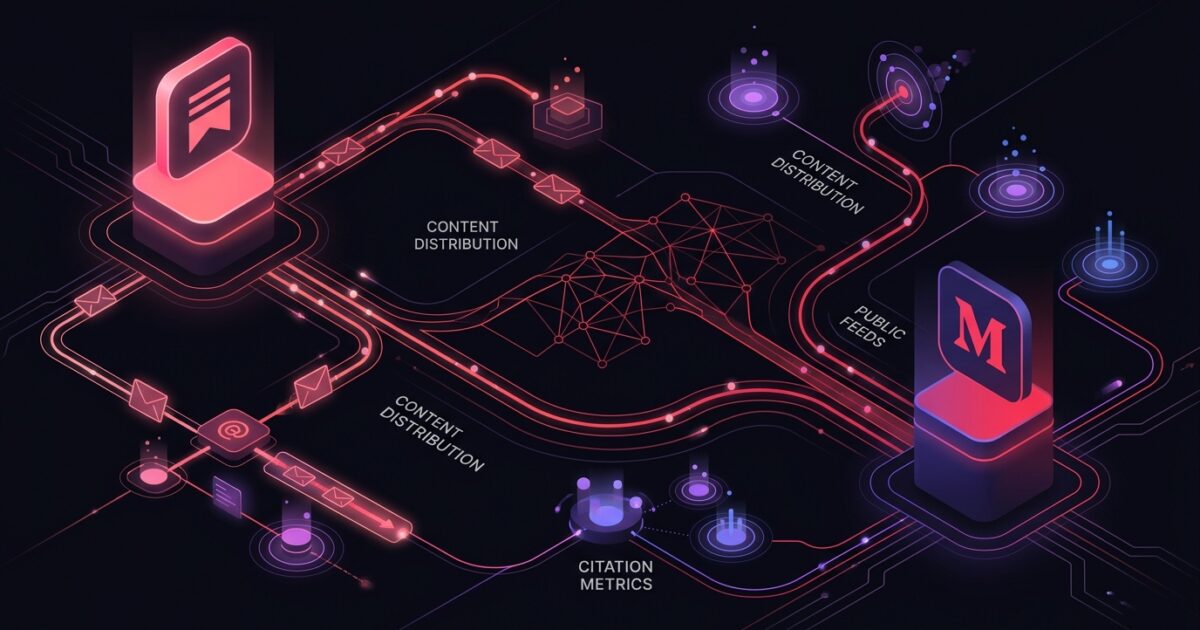
Third, canonical handling. Medium honours canonical link tags. If you republish a Substack post to Medium with a rel=canonical pointing at your Substack URL, Google and AI crawlers attribute the original to your owned domain. Medium still earns the citation lift from its authority, but your domain gets the SEO credit. This is the core mechanic of a dual-platform strategy.
Platform Comparison: What Each Surface Gives You
| Factor | Medium | Substack (custom domain) |
|---|---|---|
| Domain authority at launch | Inherited from medium.com (high) | Starts from zero, builds to your brand |
| AI crawler priority | High: already trusted by all major crawlers | Medium: depends on your domain’s authority |
| Schema markup control | None: no custom code injection | Full: custom head injection available |
| Email list ownership | No: followers are Medium’s | Yes: list is yours, portable anytime |
| Subscription revenue | Partner Program (unpredictable per-read rates) | 100% minus a 10% platform fee plus ~3% processing |
| Custom domain | Not available | Available ($50 one-time fee) |
| Internal discovery | Strong: algorithmic recommendation engine | Weaker: relies on cross-publication notes |
| Brand citation credit | Accrues to medium.com | Accrues to your domain |

The Owned Domain Principle: Why Citation Credit Matters
The core principle in our GEO work is that AI citation credit flows to the domain, not the author. When an AI assistant cites a Medium article, it attributes the source as medium.com in its training and retrieval weighting. Your name may appear in the byline, but the domain authority signal reinforces Medium, not you. When the same article lives on your Substack custom domain and is cited, that citation reinforces your domain. Over twelve months of consistent publishing, the compounding difference between these two citation patterns is the difference between being a Medium contributor and being a cited expert with a recognised domain.
This is the argument for Substack as the primary surface and Medium as the amplifier, not the reverse. In our May 2026 study of 153,425 AI citations, the two most-cited domains were YouTube (9,868 citations) and Reddit (6,595), with Wikipedia seventh (1,483). These are all platforms with massive own-domain authority. Individual contributors who build authority on their own custom domains are building the same compounding asset at a smaller but defensible scale.
AI citation credit flows to the domain. Medium citations reinforce medium.com. Custom-domain Substack or own-site citations reinforce your brand. Own your primary surface.
E-E-A-T Signals on Each Platform
E-E-A-T signals work differently on each platform and interact with AI citation probability in distinct ways.
Medium exposes author bio, follower count, and topic-level expertise tags (“Top writer in AI”) that AI parsers can extract as authority cues. These signals are platform-native and apply to every Medium author uniformly. They are useful but generic. Substack exposes subscriber count, paid subscriber count, and publication tenure, all of which can also be extracted. The markup is less standardised across writer themes, which means AI parsers read it less consistently.
The decisive E-E-A-T advantage for Substack on a custom domain is the ability to inject Article schema with explicit author, publisher, and sameAs properties linking to your LinkedIn, Wikipedia, or Wikidata entity. This lets AI parsers resolve authorship to a known entity rather than a string match on a byline. For a practitioner with external credentials (research papers, conference talks, published work), Substack custom domain plus full schema lets you compound those credentials directly into AI citation probability. The Person schema and E-E-A-T guide covers the exact schema structure.
For a newer writer building authority from scratch with no external entity signals, Medium provides a faster runway because the platform vouches for you implicitly. The tradeoff: that borrowed authority never becomes yours. The moment you stop publishing on Medium, the citation association weakens. Authority built on your own domain persists.
The Dual-Platform Strategy: When and How to Cross-Post
Cross-posting is a deliberate move that costs editorial time and creates canonical complexity if done carelessly. The pattern that works: publish original on your highest-control platform first, wait 7 to 14 days for it to be crawled and indexed, then republish to Medium with a canonical link pointing at the original.
- Day 0: publish original on your owned platform (custom-domain Substack, Ghost, or self-hosted) with full Article and Person schema.
- Day 1 to 7: let GPTBot, ClaudeBot, and PerplexityBot crawl the original. Verify in server logs.
- Day 8 to 14: republish to Medium with rel=canonical pointing at the original URL. Update your internal links to reference the original.
- Day 15 onward: monitor AI citation share across both URLs. Medium typically catches up within 30 days but the original retains canonical credit for SEO.
- Quarterly: review whether Medium republications older than six months are cannibalising search traffic from the original. Add noindex to old syndications if so.
Avoid cross-posting time-sensitive content (deal pages, event announcements) because Medium’s slower indexing means the content expires before the citation lifts. Cross-post evergreen frameworks, opinion pieces, and how-to content where the citation half-life is long. For content with deep niche specificity, the authority gap between Medium and your own domain narrows: a highly specific long-tail article earns citations based on content quality more than domain weight, and original data compounds that advantage regardless of which platform carries it.
Monetization and the Right Stack for B2B
Direct platform revenue is a small variable for most professional writers and a meaningful one for full-time creators. Substack takes a 10% platform fee plus payment processing (around 87% net to you) and you keep the email list permanently. Medium pays via the Partner Program based on member reading time, which produces highly variable monthly payouts. For most writers the per-read rate is unpredictable and modest.
For consultants, agencies, and B2B founders, neither platform’s direct payment matters much. The real revenue is downstream: consulting, product sales, and hiring advantage. From that lens, Substack outperforms because the email list converts directly to discovery calls and product trials. Medium readers are largely anonymous and convert at lower rates. The AI citation lift from Medium adds a third layer of indirect revenue (brand recognition in AI answers leads to inbound consideration) that does not appear in either platform’s analytics.
Our recommendation for B2B and consulting brands: own a Substack on a custom domain as the primary publishing surface, treat Medium as a citation amplifier via canonical syndication, and skip Medium’s monetization program. The expected return on the owned-domain stack is asymmetric: compounding AI citations plus owned email list plus consulting pipeline, for a total cost under $100 per month (Substack custom domain fee plus optional analytics tooling). For context on how to measure whether that citation lift is working, the citation velocity framework tracks how fast AI platforms pick up new content from any publishing surface.
What Honest Guidance Looks Like Without a Citation Study
No peer-reviewed study compares Substack and Medium AI citation rates head-to-head with controlled methodology. Claims you may encounter that cite specific multipliers (2x, 3x) from unnamed Q1 2026 experiments should be treated as practitioner estimates, not verified data. We do not have that data and we will not fabricate it.
What we do have: the structural mechanics described above, verified against platform documentation and our own citation research. The principle that domain authority correlates with AI citation probability is consistent with every data set we have run, including the May 2026 study showing 76.95% of cited URLs are outside the organic top-10, which confirms AI systems are not simply mirroring Google rankings but are drawing on a broader authority signal. The GEO fundamentals apply to publishing platform choice: own your primary citation surface, optimise its structure, measure the result.
For developers and technical writers, the same principle extends to GitHub README content and Stack Overflow documentation, where platform domain authority also creates a citation head start over personal blogs. The underlying logic is consistent: high-authority platform domains earn faster citations, owned domains earn compounding brand credit. Pick your priority and design your publishing stack accordingly.