TL;DR
- New sites can earn first AI citations in 6-8 weeks with an entity-first playbook.
- Our May 2026 study of 153,425 citations found 76.95% outside the organic top-10, so entity recognition gates eligibility.
- The 90 days: entity setup days 1-14, one topic cluster days 15-45, earned mentions days 30-60, original research days 45-75, measurement days 60-90.
- The arXiv GEO paper (KDD 2024) found visibility gains up to 40%, with rank-5 sites up 115.1%.
- Broad multi-topic strategies on new domains rarely see citations before month four or five.
New sites can earn their first AI citations in 6-8 weeks using a focused entity-first playbook. The critical insight: AI engines run an entity resolution pass before they evaluate any content, so a brand with no entity record is invisible to retrieval regardless of content quality. In our client work, the brands that close this gap fastest concentrate on three things in sequence: entity establishment, one deep topic cluster, and earned mentions in entity-rich sources.
Why new sites fail in AI search
AI engines weight entity recognition heavily. A new brand without a record in knowledge graphs like Wikidata is filtered out before content scoring begins. It does not matter how well your pages rank or how much content you publish: if the entity resolution pass returns nothing, your content is excluded from the citation pool.
In our May 2026 study of 153,425 AI citations, 76.95% of cited URLs were not in the organic top-10 for their query. Entity recognition, not ranking position, is the primary gate. This is the structural reason why new sites fail: they invest in content before building the entity layer that makes content retrievable.
Broad coverage makes this worse: spreading effort across five or more topics in the first 90 days starves all of them of the depth AI engines use to judge topical authority. In our client experience, focused single-cluster strategies produce first citations in roughly 6-8 weeks, while broad multi-topic strategies on new domains rarely see citations before month four or five.
Entity resolution failure is the root cause of new-site invisibility in AI search. Fix the entity layer before investing in content volume.
The 90-day phased plan
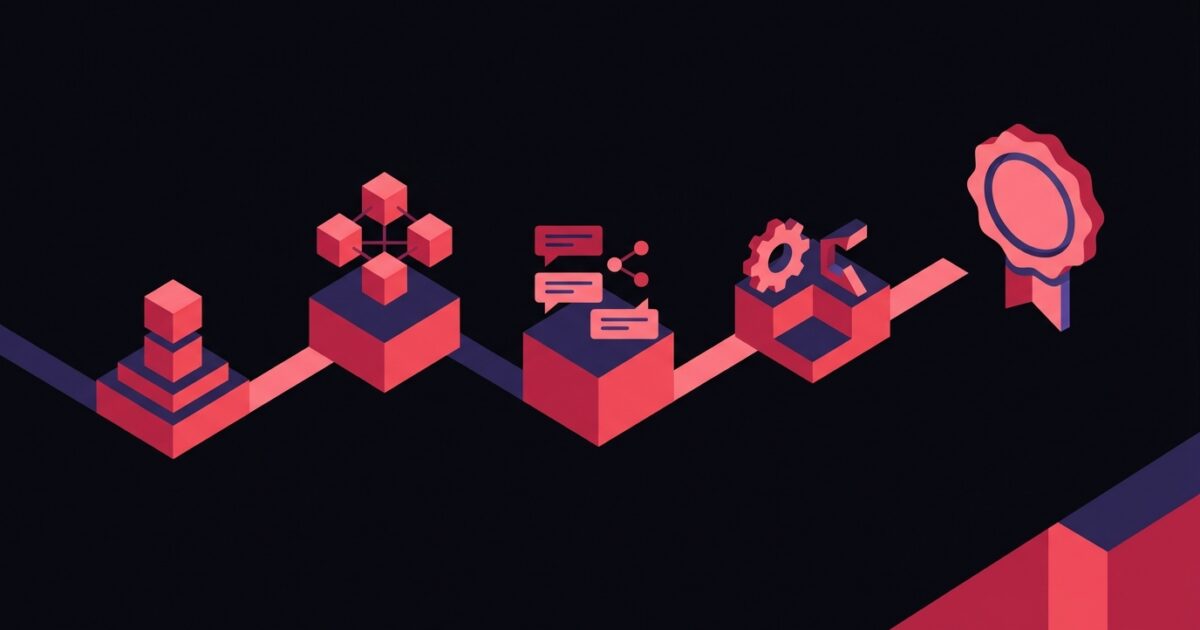
This is the exact sequence we run for new-brand clients. Each phase builds on the previous one; skipping the order degrades results.
- Days 1-14: Entity establishment. Wikidata entry, comprehensive Organization and Person schema, consistent name and URL across all profiles. This is the prerequisite layer. Nothing else works until it exists.
- Days 15-45: Cluster build. One pillar page plus 15-25 cluster pages on a single topic where you have genuine expertise and can produce original insight. Generic educational content from unknown domains gets filtered. Practitioner perspective backed by evidence earns citations.
- Days 30-60: Earned mentions. 5-10 podcast appearances, byline placements in industry publications, expert quotes in journalist pieces. Target sources that already appear in AI citations: a mention on a podcast or outlet that AI engines cite carries authority by association.
- Days 45-75: Tool or original research launch. One free tool, calculator, or original data study to anchor citation share. Our own GEO/AEO Tracker is an example of this approach: a free open-source tool that earns citations because it provides something non-derivative.
- Days 60-90: Measurement and iteration. Track citation share by category and double down on patterns that produce citations. The arXiv GEO paper (KDD 2024) found that optimized content strategies boosted AI visibility by up to 40%. The gains concentrate on brands that measure and iterate, not set-and-forget.

Entity establishment: the foundation layer
AI engines rely on structured entity recognition before they evaluate content quality, so a new brand without a record in knowledge graphs is invisible to retrieval regardless of content depth. The entity layer has two components: Wikidata (the public knowledge base) and Organization schema (your owned on-site signal). Wikidata has lower notability thresholds than Wikipedia and accepts businesses with verifiable existence and basic independent coverage; a registration, directory listing, and one or two news mentions typically suffice. The minimum viable entry needs official name, instance of, founding date, official website, and location.
Once the Wikidata entry exists, link it from your Organization schema using the sameAs property. The brand name, canonical URL, and description must be character-for-character identical across your schema, Wikidata item, and every sameAs profile; a single difference (“Inc.” versus “Inc”) prevents entity merging. Person schema for founders amplifies entity authority, because a verified individual tied to your organization carries citation trust that generic brand profiles do not.
Wikidata entry plus comprehensive Organization schema creates the entity anchor AI engines use for attribution. Without it, no content strategy works at scale.
The focused cluster build strategy
New sites succeed by going deep on one topic cluster before expanding. The 90-day plan dedicates weeks 2-6 to one comprehensive pillar page plus 15-25 supporting cluster pages on a single subject where you have genuine expertise. Topic selection matters more than execution quality at this stage: choose a cluster where you can demonstrate unique insight through original data, case studies, or practitioner experience. Generic educational content from new domains gets filtered out, because AI engines use depth and specificity as proxy signals for authority while entity confidence is still building.
| Strategy | Topic spread | First citation (our estimate) | Month-3 citation volume |
|---|---|---|---|
| Focused single cluster | 1 topic, 15-25 pages | Weeks 6-8 | Moderate, concentrated on cluster |
| Broad multi-topic | 5+ topics, 3-5 pages each | Month 4-5 | Low, spread thin across topics |
| No cluster (ad-hoc posts) | No structure | Rarely before month 6 | Near zero on new domains |
- Pillar depth: 3,500-5,000 words with embedded data, examples, and procedural frameworks
- Cluster pages: 1,200-2,000 words each on specific sub-topics, each linking back to the pillar
- Cadence: 3-4 cluster pages per week to build indexing momentum and signal topical authority
Every page in the cluster should include Article schema with author attribution, publication date, and lastReviewed timestamps. Schema consistency across the cluster reinforces the entity-topic association in knowledge graphs.
One complete cluster (pillar plus 20 supporting pages) consistently outperforms 20 unconnected topic pages for new-site citation share in our client work.
Earned mentions and backlink seeding
New sites need earned backlinks and brand mentions to trigger AI crawling, but the goal in the first 90 days is quality and diversity, not volume: five high-authority mentions in entity-rich contexts outperform 50 directory links. Podcast appearances are the highest-impact early tactic. A 30-minute podcast generates a transcript (AI-crawlable text), show notes with your name and company, and often a dedicated landing page, and AI engines weight transcripts because they carry conversational expertise signals. Target established industry podcasts rather than new shows: a mention on an outlet that already appears in AI citations carries authority by association.
Expert quote placement in journalist pieces is the second-highest return tactic. Services like HARO connect journalists with expert sources; respond with specific, quotable insights. One quote in a major publication creates an authoritative backlink plus an entity mention in a verified news context.
- Guest articles in industry publications with full byline and company attribution. Avoid promotional tone: in our client work, promotional content tends to underperform informational, declarative writing for AI citation.
- Bylined commentary on breaking news in your category. Fast-response pieces that reference timely events signal freshness to retrieval bots.
- Tool or data partnerships where your tool or research is featured in a larger analysis piece. This is the highest-trust format because it requires another entity to vouch for yours.
Track every backlink and mention in the GEO/AEO Tracker and note which sources correlate with citation appearances within 30 days. Some links drive citation authority quickly; others take months. Prioritize more of what works based on actual data, not assumptions.
Wikipedia and Wikidata pathways for new brands
Most new brands cannot create a Wikipedia article in the first 90 days because notability requires significant independent coverage that typically takes 12-24 months to accumulate. The alternate pathway is Wikidata without Wikipedia: the Wikidata entity guide covers the process, and the core requirement is at least two independent reliable sources (directory listings, news coverage, third-party analysis; not press releases or owned content). For indirect Wikipedia inclusion, a founder or CEO personal page is often easier to establish than a corporate one, and your company can then be mentioned there with a Wikidata link. Industry list articles offer another route to a Wikipedia backlink without a standalone article.
Original research as a citation anchor
Publishing original research gives AI engines something non-derivative to cite. Original data that no one else has published creates a citation edge: AI engines cite you because you are the primary source, not because you rank, while generic content competes against thousands of established sources on the same facts.
The arXiv GEO study (KDD 2024, arXiv:2311.09735) confirmed that citation-signal optimization, which includes publishing original statistics and citing sources, boosted AI visibility by up to 40%. Rank-5 sites using these signals gained 115.1% visibility. The mechanism is that AI engines weight unique factual claims differently from rephrasings of common knowledge.
For new brands without existing research infrastructure, the minimum viable original research formats are: a small-scale survey (50+ respondents from your target audience), a dataset study using publicly available data that you analyze in a novel way, or a transparency report about your own process or performance. Each of these creates citable facts that only your brand can attribute to itself. For a deeper look at how we run our own research, see the March 2026 citation study and the May 2026 study.
Original research creates a citation edge. AI engines cite primary sources. Generic content from new domains competes against thousands of established sources on the same facts.
Common failure modes to avoid
- Skipping entity establishment. Content published before a Wikidata entry and Organization schema exist will not get the entity resolution pass it needs. Build the entity layer first, every time.
- Promotional content tone. In our client work, promotional tone tends to underperform for citation selection. AI engines weight informational, declarative content over promotional framing.
- No author identity. Anonymous content from unknown brands is the worst citation candidate. Named, schema-attributed authors with E-E-A-T signals perform materially better.
- Measuring traffic instead of citations. Traffic metrics lag citation share by weeks and obscure which content is driving AI authority. Use a citation tracking framework from day one.
Measurement and iteration framework
Track five metrics weekly throughout the build: entity recognition status, cluster coverage, earned mentions, initial citation appearances, and citation share trajectory. In our client experience, brands that execute the entity and cluster build consistently see first AI citations in weeks 6-8, typically from ChatGPT or Perplexity because those engines weight recent, specific content more heavily than broad authority. When you spot the first citation, analyze the query and content that triggered it and double down. Citation patterns are self-reinforcing: one citation creates query-content associations that raise the probability of future citations in related queries. Track citation share with the GEO/AEO Tracker, connect each citation to the entity signals that preceded it, and use our co-citation analysis guide to identify the sources worth targeting next.
The founder thought leadership layer accelerates this loop. A named, schema-attributed founder with their own entity record gives AI engines a person-level anchor for your brand’s expertise, which is especially valuable in months 1-3 before the organization entity has accumulated enough corroborating mentions on its own.
Measure citation share weekly, not traffic. Brands that iterate on working patterns achieve compounding citation growth. Set-and-forget approaches plateau.
What to do in the first two weeks
Starting from zero today, the sequence is: create or claim your Wikidata entry, deploy Organization and Person schema on your About page, run a GEO audit to check your entity recognition status, then pick your first topic cluster and publish at 3-4 pages per week. Do not pitch links or podcasts before the entity layer is live: mentions pointing to a brand with no entity record create backlink value but do not trigger the entity resolution that enables citation eligibility. Entity first, then content, then distribution. For the full checklist, see the brand entity optimization guide and the GEO audit checklist.