TL;DR
- Perplexity Pro and Free share the same retrieval infrastructure: 200 million daily queries, an index of over 200 billion URLs, hybrid lexical and semantic retrieval, and span-level passage scoring.
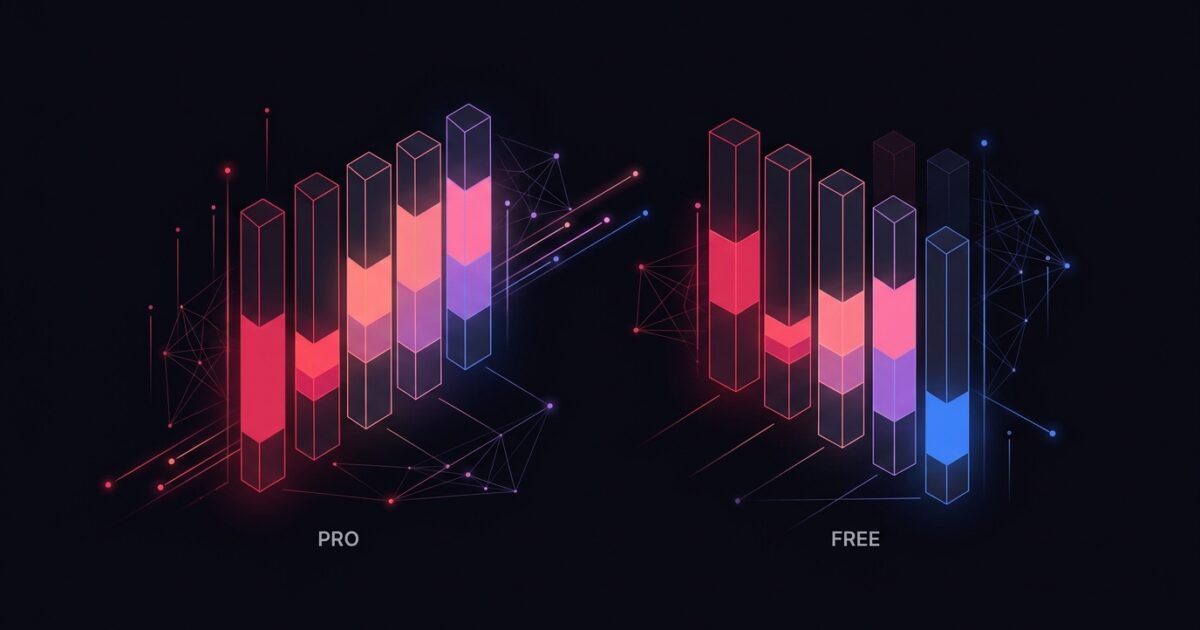
- The model layer is where the tiers diverge.
- Pro unlocks frontier model selection (Sonar 2, GPT-5.6 Terra, Gemini 3.7 Flash, Claude Sonnet 5) and documented access to premium sources including Pitchbook and Wiley.
- Free uses Sonar by default.
- In our prompt panel observations, Pro produces more citations on complex queries, with a higher preference for primary research over aggregator summaries.
- Our May 2026 study of 153,425 citations placed Perplexity at 39.4% organic top-10 overlap.
- Cited sentences average 9.27 words; the 6-10 word range accounts for 45.2% of citations across both tiers.
- Freshness gating and PerplexityBot crawl behavior are tier-agnostic.
- Optimize for both tiers with Free as the baseline.
Perplexity Pro and Free are not the same product from a citation standpoint. Pro adds access to more capable reasoning models, deeper sourcing from proprietary databases, and a search infrastructure that runs 200 million daily queries across an index of over 200 billion URLs. Free users get Sonar by default. The gap between them matters for anyone optimizing to appear in Perplexity answers.
This post covers what Perplexity officially documents about the tier differences, what we observe running prompt panels on both accounts, and what it means for your Perplexity citation strategy. Our May 2026 study of 153,425 citations placed Perplexity at 39.4% organic top-10 overlap, second only to Gemini at 41.1%. The remaining 60.6% of Perplexity citations go to pages outside the top-10. That gap is where tier optimization lives.
What Perplexity officially documents about the Pro tier
Perplexity’s Pro plan page documents four differentiators relevant to search and citation behavior. First, Pro gives access to a rotating set of frontier models: as of August 2026 the listed options include Sonar 2, GPT-5.6 Terra, Gemini 3.1 Pro, Claude Sonnet 5, Kimi K3, and GLM 5.2. Free accounts use Sonar by default. Second, Pro includes “deeper sourcing from Perplexity’s index, including proprietary financial and scientific data from Pitchbook, Wiley, and more.” That premium source access is not available on the Free tier. Third, Pro is described as “better for complex questions and building reports, documents, and apps,” which reflects the model capability gap. Fourth, the Max tier (above Pro) adds the ability to “run deep investigations at any scale” and “work with massive datasets and files.”
Perplexity does not publish an official per-response citation count by tier. What they document is the model and source access difference, from which the citation behavior differences follow. We are explicit about this distinction throughout: the numbers below come from our prompt panel observations, not from Perplexity’s published specs.
The underlying retrieval system is the same for both tiers
Both Pro and Free run on the same search infrastructure. Perplexity’s published architecture paper describes a system that processes 200 million daily queries using a multi-stage pipeline: hybrid lexical and semantic retrieval, prefiltering to remove stale content, and multiple reranking stages culminating in cross-encoder models that perform final result selection. The index tracks over 200 billion unique URLs. An ML model predicts “whether any given candidate URL needs to be indexed,” calibrating that decision to “both the importance and likely update frequency of the specific URL.”
Retrieval happens at both the document and sub-document (span) level. A single 4,000-word page can contribute multiple individually cited passages. This architecture is tier-agnostic. The span-level pipeline runs regardless of whether the query comes from a Free or Pro account.
What differs between tiers is the model that sits downstream of retrieval. More capable models execute more query expansion steps, evaluate a broader candidate set, and make different synthesis judgments about which passages to surface. The model is the variable. The index and retrieval engine are shared.
What we observe running prompt panels on both tiers
We run regular prompt panels on Perplexity accounts to track citation behavior for clients across industries. The observations below are from our client work and internal testing. They are behavioral observations, not controlled studies with statistical significance. We surface them as practitioner data.
On complex multi-part queries, Pro responses consistently cite more sources per answer than Free responses on the same prompt. The gap is most pronounced on technical, academic, and financial topics where the premium source access to Pitchbook and Wiley changes the candidate pool. On simple factual queries with high-confidence answers, both tiers produce similar citation sets because the retrieval result is decisive before the model makes synthesis choices.
Pro responses on advanced reasoning models (we tested primarily Sonar 2 and GPT-5.4) show a higher frequency of citing primary research and official documentation versus secondary summaries. This aligns with what Perplexity’s architecture paper describes as “fine-grained content understanding”: the more capable cross-encoder reranker models better distinguish between a primary source and an aggregator restating the primary source. If your content is the original source of a claim, Pro’s model stack is more likely to find and cite you. If your content restates a fact from elsewhere, Pro is more likely to route around you to the original.
On time-sensitive queries, both tiers behave similarly. Perplexity’s freshness gate operates at the index level. The ML model that determines “whether any given candidate URL needs to be indexed” and schedules indexing to “the point in time that they are likely to be most useful” applies equally. Neither tier gets more recent results than the other. Content freshness signals like visible publication dates and Article schema help both tiers identify your page as fresh.

The citation count question: what is and is not documented
The Perplexity Pro page lists “More usage limits and memory” as a Pro benefit and does not specify citation count limits for either tier. Pro is described as having access to “deeper sourcing.” We have seen community reports of Free responses capping at 5-7 citations on complex queries while Pro responses reach 10-15 on the same prompt. We cannot string-match a citation count specification on Perplexity’s own documentation pages. Those numbers represent our observations and community observations, not Perplexity’s published specs.
What Perplexity does document is the model access difference, and more capable models produce longer synthesis responses with broader source coverage on complex queries. That is the documented mechanism behind the citation count gap, even if Perplexity does not publish the exact numbers.
GEO strategy implications by tier
Three practical differences affect how you should think about GEO optimization for Perplexity specifically.
Primary source status matters more on Pro
On academic and financial topics, Pro users can query Pitchbook and Wiley data directly through Perplexity’s premium source integration. If you are a SaaS company producing original market data, your proprietary figures compete with licensed databases on Pro queries. Being the original source of a number becomes a stronger advantage when the model is capable enough to distinguish primary from secondary.
Entity consistency amplifies on advanced models
On Pro, cross-encoder rerankers perform more passes and are better at detecting entity consistency. Standardizing your brand, author, and product entity representation across web platforms, particularly through sameAs schema links and earned media mentions, pays larger dividends on Pro queries. The same signal amplification is weaker on Free because Sonar’s reranking passes are less thorough.
Free tier optimization covers the larger audience
Most Perplexity users are on the Free tier. Free still means an account: logged out, Perplexity answers nothing at all while ChatGPT answers, so every Perplexity citation you earn reaches someone who has already signed up. Perplexity processes 200 million daily queries total. Pro subscriptions are a fraction of that query volume. Optimizing exclusively for Pro behavior is a mistake. The passage-level citation patterns from our May 2026 study apply to both tiers: cited sentences average 9.27 words, the 6-10 word range accounts for 45.2% of citations, 74.9% of cited sentences sit in the first half of the source document. Those structural patterns hold regardless of which model generates the response.
Comparison: Pro vs Free citation-relevant features
| Feature | Free | Pro |
|---|---|---|
| Default model | Sonar | Sonar 2, GPT-5.6 Terra, Gemini 3.7 Flash, Claude Sonnet 5, Kimi K3, GLM 5.3 (user selects) |
| Premium source access | No | Yes (Pitchbook, Wiley, and more per official page) |
| Retrieval infrastructure | Shared: 200B URL index, hybrid retrieval | Shared: 200B URL index, hybrid retrieval |
| Span-level passage scoring | Yes | Yes |
| Query expansion depth | Standard (Sonar) | Higher on frontier models (observed, not documented) |
| Citation counts on complex queries | 5-7 typical (observed) | 10-15 typical (observed) |
| Freshness gating | Same ML-driven index schedule | Same ML-driven index schedule |
| robots.txt compliance | Yes (PerplexityBot) | Yes (PerplexityBot) |
How to track your visibility across both tiers
Testing your brand share of voice on Perplexity requires testing on both tiers with matched prompts. The simplest approach: build a 20-30 query panel covering your primary topics, run each query on both a Free and Pro account simultaneously, and record which sources are cited per tier. You are looking for three patterns: queries where you appear on both tiers, queries where you appear only on Pro (suggesting your content passes the higher-authority filter), and queries where you appear on neither (citation gap).
Our open-source GEO/AEO Tracker automates this cross-platform citation testing across Perplexity, ChatGPT, Gemini, and other platforms. For Perplexity specifically, the tracker uses the Sonar API as a proxy for Free tier behavior. Pro tier testing requires a live account with manual or API-based prompt execution.
A measurement framework for this captures tier-specific citation behavior alongside organic rank and AI Overview presence. For sites that already rank well on traditional SEO, the Perplexity measurement is typically an additive check: you are confirming that passage quality and freshness are converting your ranking authority into citation authority.
Span-level optimization, freshness signaling, and the Publishers Program authority signals apply to both tiers. Tier-level citation data belongs in the same report as the rest of your GEO KPIs.
The tier split only matters if the platform keeps growing, so Perplexity’s share against Google is the number to watch behind all of this.
Whichever tier your buyers are on, the work underneath is the same: short declarative sentences, clean schema, and attribution that ties citations to revenue.