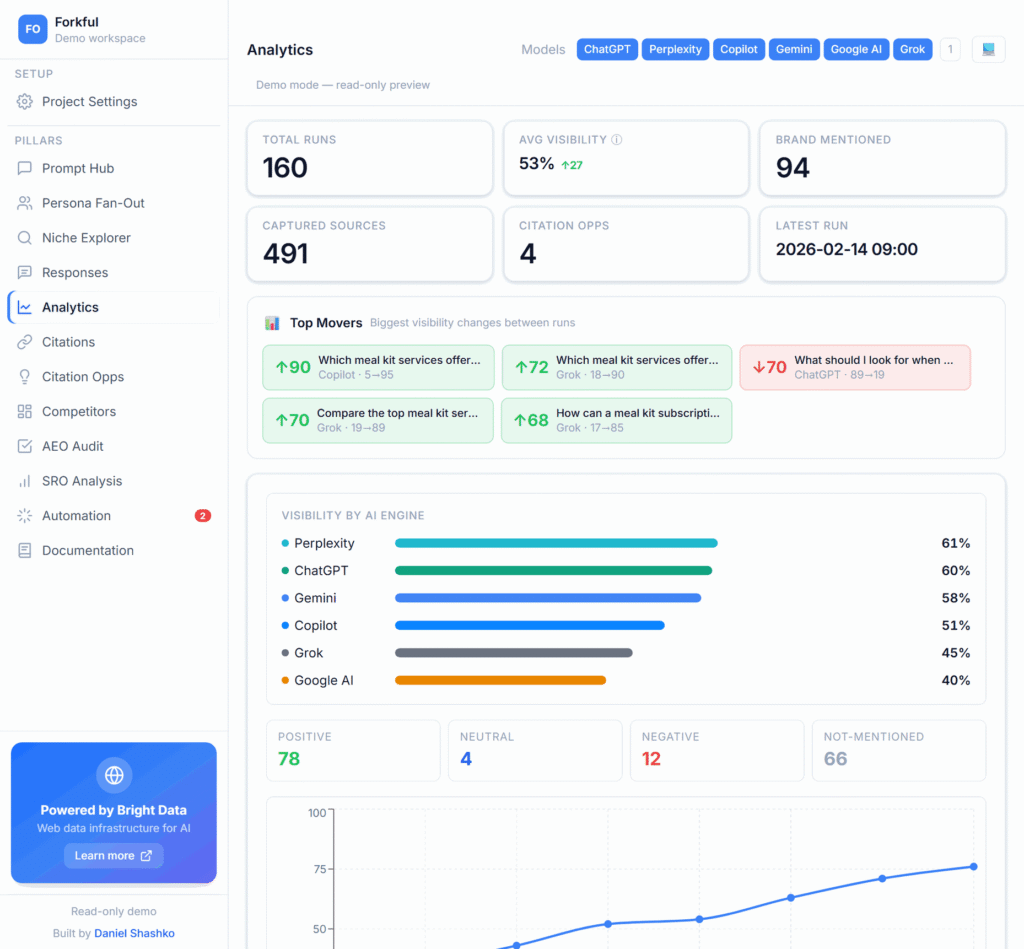
Buyers no longer start their research on Google. In 2026, B2B SaaS prospects open ChatGPT, Perplexity, Claude, and Gemini first, then ask the AI to recommend a vendor. If your brand is not cited in those answers, you do not exist in the consideration set.
OrganikPI’s Generative Engine Optimization (GEO) service engineers your visibility inside large language models. We build the citation-worthy content, entity signals, and technical foundations that AI engines surface when buyers ask about your category.
Why GEO matters now
63% of B2B software buyers report they consult an AI assistant before scheduling a sales call (Forrester, Q1 2026). Brands that win citations in those AI answers shape the shortlist. Brands that don’t, are invisible.
What is Generative Engine Optimization?
Generative Engine Optimization (GEO) is the practice of optimizing your brand, content, and digital footprint so that large language models, the engines behind ChatGPT, Perplexity, Claude, Gemini, Google AI Overviews, and Microsoft Copilot, cite you when answering buyer questions in your category.
GEO vs. SEO: what changed
Traditional SEO optimizes for ranked links on a search results page. The user clicks. You get traffic.
GEO optimizes for citations inside an AI-generated answer. The user reads the answer. You get a brand mention, a link, and downstream demand. The interaction model is different, and so is the optimization playbook.
Where GEO fits with AEO
Answer Engine Optimization (AEO) focuses on Google’s AI Overviews and featured-snippet style answers. GEO is broader, it covers every generative engine, including the standalone LLM chat surfaces. Most of our engagements include both.
Our GEO service framework
We run a four-pillar engagement designed for B2B SaaS go-to-market teams. Every pillar is measurable, and every deliverable maps to a specific citation-driving outcome.
1. AI visibility audit
We baseline your current citation footprint across ChatGPT, Perplexity, Claude, Gemini, and Google AI Overviews. You get a 50-point readiness scorecard, a competitive share-of-voice analysis, and a prioritized fix list ranked by impact and effort.
2. Citation-worthy asset production
We build the four asset types AI engines disproportionately cite: original research, expert thought leadership, comparison pages, and use-case documentation. Every asset is structured for entity recognition and source-worthy attribution.
3. Entity & technical foundations
We optimize Organization schema, author E-E-A-T signals, llms.txt, robots.txt for AI crawlers, semantic HTML, and internal linking. These are the unsexy fundamentals that compound over 90 days.
4. Tracking, reporting, and iteration
Monthly citation reports across all major engines. Quarterly strategy reviews. Continuous optimization based on what actually converts to pipeline.
What’s included
- Initial AI readiness audit (50-point scorecard + roadmap)
- Competitive citation analysis across 5 generative engines
- Production of 4-8 citation-worthy content assets per quarter
- Entity optimization (Organization, Author, Article schema)
- Technical setup: llms.txt, robots.txt, semantic structure
- Monthly citation tracking dashboard (ChatGPT, Perplexity, Claude, Gemini, Google AI)
- Quarterly strategy reviews with founder-led insights
- Slack channel access for ongoing questions
Who this is for
We work best with B2B SaaS companies between Seed and Series B. You have product-market fit, a content engine that produces something, and a marketing leader who knows organic search is shifting under their feet. You don’t need to be enterprise, you need to care about being defensible in the AI era.
Best fit
- B2B SaaS companies, $1M-$50M ARR
- Marketing teams of 1-15
- Founders or marketing leaders directly involved
- Categories where buyers research before buying (most B2B SaaS)
Not a fit
- E-commerce or D2C consumer brands
- Companies expecting GEO to replace paid demand gen overnight
- Teams without any content production capacity
How it works
Week 1-2: Audit and baseline
Kickoff call, technical and content audit, competitive scan, baseline citation report. You’ll know exactly where you stand in AI search before we touch anything.
Week 3-6: Foundations and first assets
Entity optimization, llms.txt, schema deployment, and the first two citation-worthy assets go live.
Week 7-12: Asset velocity and tracking
Continued asset production, monthly citation reports, and iterative optimization. First citations typically appear within 60-90 days.
Quarter 2+: Compound and expand
Move from initial visibility to category share-of-voice. Expand to additional engines and content categories based on what’s working.
Pricing & engagement models
We work in three engagement models depending on stage and ambition. All include the audit, asset production, tracking, and ongoing strategy.
| Tier | Best for | Investment |
|---|---|---|
| GEO Foundations | Seed / early Series A | From $4, 500/mo |
| GEO Growth | Series A / B with content engine | From $9, 500/mo |
| GEO Authority | Category leaders, multi-product | Custom |
Why OrganikPI
- B2B SaaS specialization, not generic enterprise consulting
- GTM × AI automation integration, we build the systems, not just the strategy
- Founder-led delivery, you work with the operator, not an account manager
- Multi-engine coverage, ChatGPT, Perplexity, Claude, Gemini, Google AI in every report
- Anti-hype, transparent reporting, you see exactly what’s working and what isn’t
Frequently Asked Questions
How long until I see citations in ChatGPT and Perplexity?
Most clients see their first citations within 60-90 days of engagement, with meaningful share-of-voice gains in months 3-6. Speed depends on your starting authority, content production rate, and category competitiveness.
How is GEO different from SEO?
SEO optimizes for ranked links on Google. GEO optimizes for citations inside AI-generated answers across ChatGPT, Perplexity, Claude, Gemini, and Google AI Overviews. The signals overlap (E-E-A-T, semantic structure, authority) but the asset types and measurement are different.
Do you guarantee citations?
No reputable GEO provider can guarantee specific citations, the engines are non-deterministic. We do guarantee the audit deliverables, asset production cadence, and monthly reporting. Our clients average measurable citation lift within 90 days.
Which AI engines do you track?
ChatGPT (with and without web search), Perplexity, Claude, Google AI Overviews, and Gemini are included in every plan. Microsoft Copilot, Meta AI, and Grok are available as add-ons.
Do I need to stop SEO to do GEO?
No, they reinforce each other. The technical foundations, E-E-A-T signals, and content quality that drive GEO citations also support traditional rankings. We treat them as one integrated practice.
What if my company is too early-stage for this?
If you’re pre-revenue or pre-product-market-fit, GEO is premature. Once you have a defined ICP and at least some content engine, the GEO Foundations tier is built for early-stage teams.
Get your AI visibility audit
Find out exactly where your brand stands in ChatGPT, Perplexity, and Google AI today, and what it takes to win citations in the next 90 days.